
Zoonotic Diseases: How Animal-to-Human Infections Spread and How to Stop Them
 Jan, 11 2026
More than 60% of all infectious diseases in humans come from animals. That’s not a guess-it’s a fact backed by the World Health Organization. Every time you pet your dog, handle raw chicken, or walk through tall grass, you’re potentially exposed to germs that jumped from animals to people long before modern medicine existed. These are called zoonotic diseases, and they’re not rare outliers. They’re the reason we’ve had Ebola outbreaks, bird flu scares, and the global pandemic that reshaped life in 2020. The truth is, we’ve been living with this risk for thousands of years. What’s changed isn’t the danger-it’s our awareness, and how poorly prepared most of us still are.
What Exactly Are Zoonotic Diseases?
Zoonotic diseases, or zoonoses, are infections passed from animals to humans. The word comes from Greek-zoon means animal, and nosos means disease. These aren’t just exotic illnesses from remote jungles. They’re right here: in your backyard, your kitchen, your pet’s fur, and even your grocery store.
They’re caused by all kinds of pathogens: viruses like rabies and Ebola, bacteria like Salmonella and Brucella, parasites like Toxoplasma, and even fungi like ringworm. Some are mild-a little stomach upset after eating undercooked eggs. Others are deadly. Rabies kills nearly everyone who shows symptoms if they don’t get treatment fast. And we’ve known this for over a century. Louis Pasteur developed the first rabies vaccine in 1885. Yet, we still don’t treat this as the urgent, shared problem it is.
How Do These Diseases Jump from Animals to People?
It’s not magic. It’s biology-and five main paths make it happen.
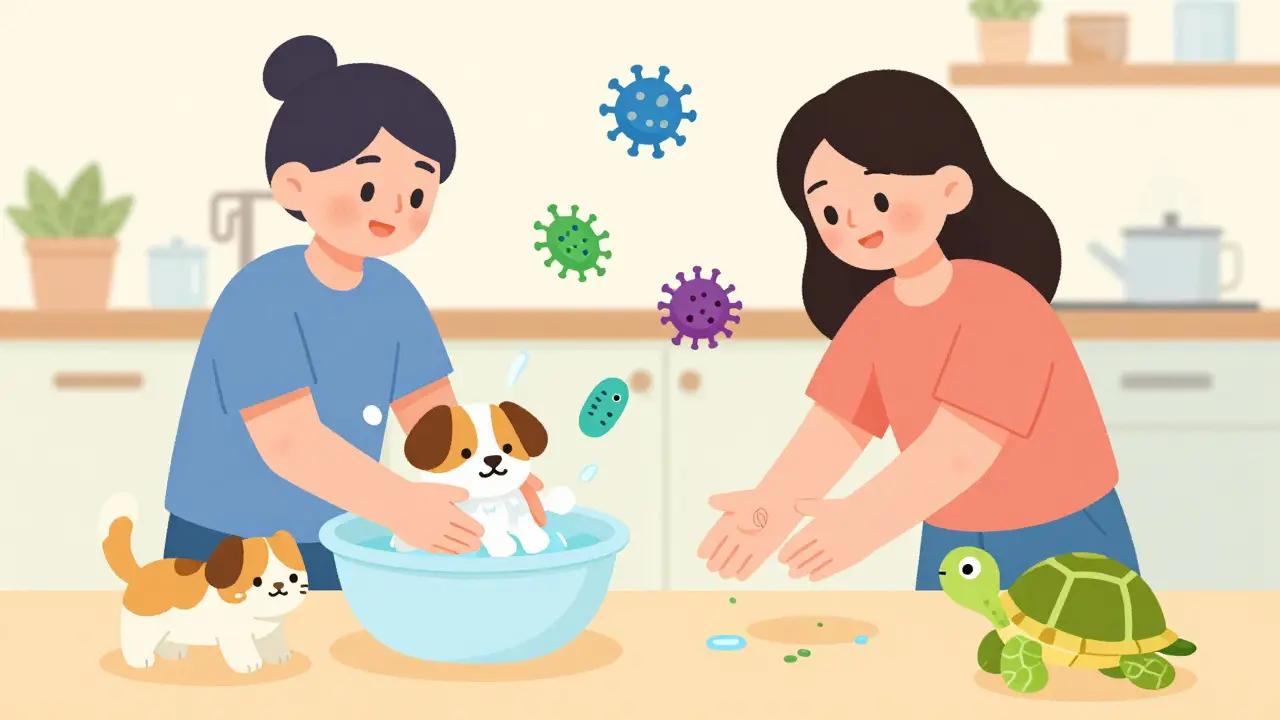
- Direct contact: Touching, being bitten, or even breathing in dust from animal droppings. A vet in Wisconsin got tularemia after handling dead rabbits. A child got salmonella from petting a turtle. These aren’t freak accidents-they’re common.
- Indirect contact: You don’t even need to touch the animal. Walking through a barn where infected sheep shed bacteria, or cleaning a reptile tank without gloves? That’s enough. The Minnesota Department of Health found every single case of campylobacteriosis linked to reptiles came from people who handled them-even just for a few seconds.
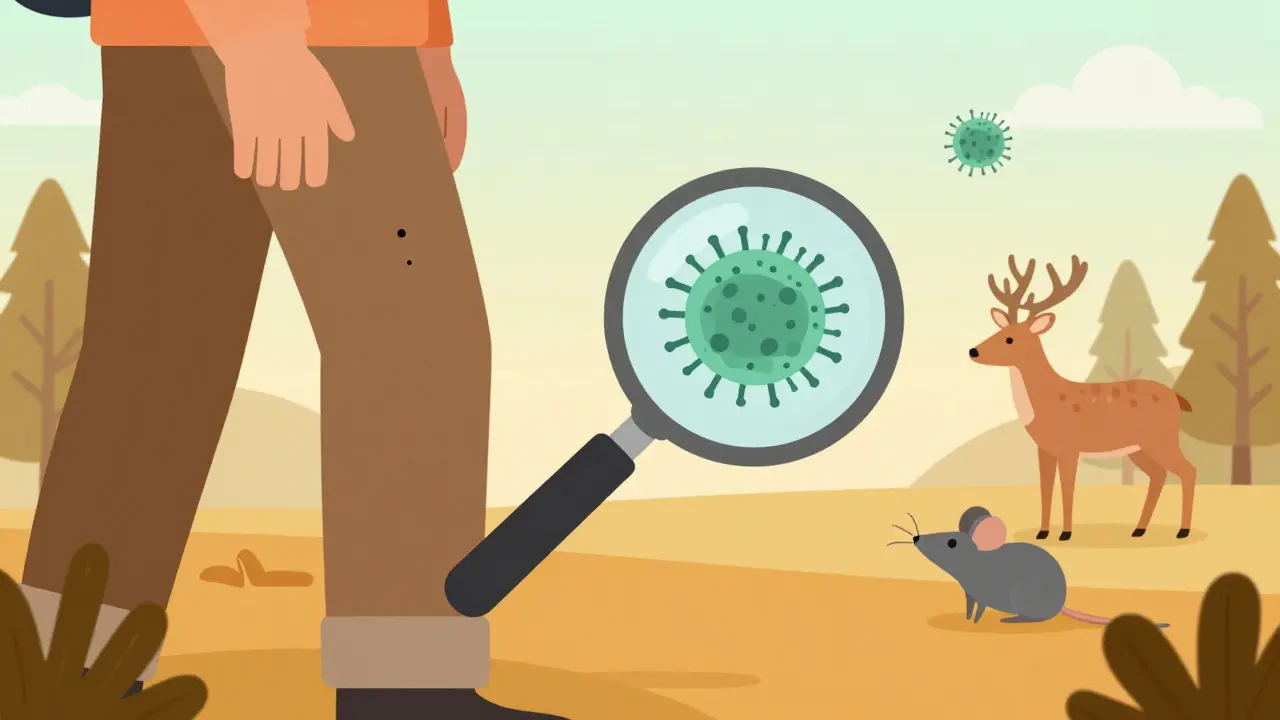
- Vector-borne: Ticks, mosquitoes, and fleas carry germs from animals to you. Lyme disease, spread by ticks that feed on deer and mice, is now common across the U.S. and Europe. Climate change is making this worse. By 2050, nearly half as many more areas in North America could become suitable for Lyme-carrying ticks.
- Foodborne: This is the biggest one. The CDC says 1 in 6 Americans get sick from contaminated food every year. Most of those cases? Zoonotic. Undercooked chicken? Salmonella. Unpasteurized milk? Brucellosis. Raw ground beef? E. coli from cattle.
- Waterborne: Drinking or swimming in water polluted by animal waste. This is a major issue in rural areas and places without clean water systems. Giardia, for example, spreads through contaminated streams and lakes.
Here’s the thing: You don’t need to be a farmer or a wildlife biologist to be at risk. Pet owners are just as vulnerable. A 2022 survey by the American Veterinary Medical Association found 23% of pet owners had been exposed to a zoonotic disease. Ringworm from cats and cat scratch disease from kittens were the most common. And 67% of them had no idea how to prevent it.
Why Are Zoonotic Diseases Harder to Control Than Regular Infections?
Normal diseases spread between people. You isolate patients, test contacts, and break the chain. Zoonotic diseases? They’re a loop. The animal is the source. Even if you stop human-to-human spread, the germs keep coming back from animals.
Take rabies. Once symptoms appear in humans, it’s almost always fatal. But in dogs, it’s preventable with vaccines. In places like Uganda, where dog vaccination programs reached 70% of the canine population, human rabies cases dropped by 92%. That’s not luck. That’s coordinated action.
But here’s the problem: Human health systems and animal health systems rarely talk to each other. In the U.S., only 28 states require doctors to report all zoonotic diseases. Veterinarians aren’t trained to alert public health officials. Doctors aren’t trained to ask, “Do you have pets? Have you been around animals?” A 2023 report found 68% of physicians lack basic training in recognizing zoonotic symptoms.
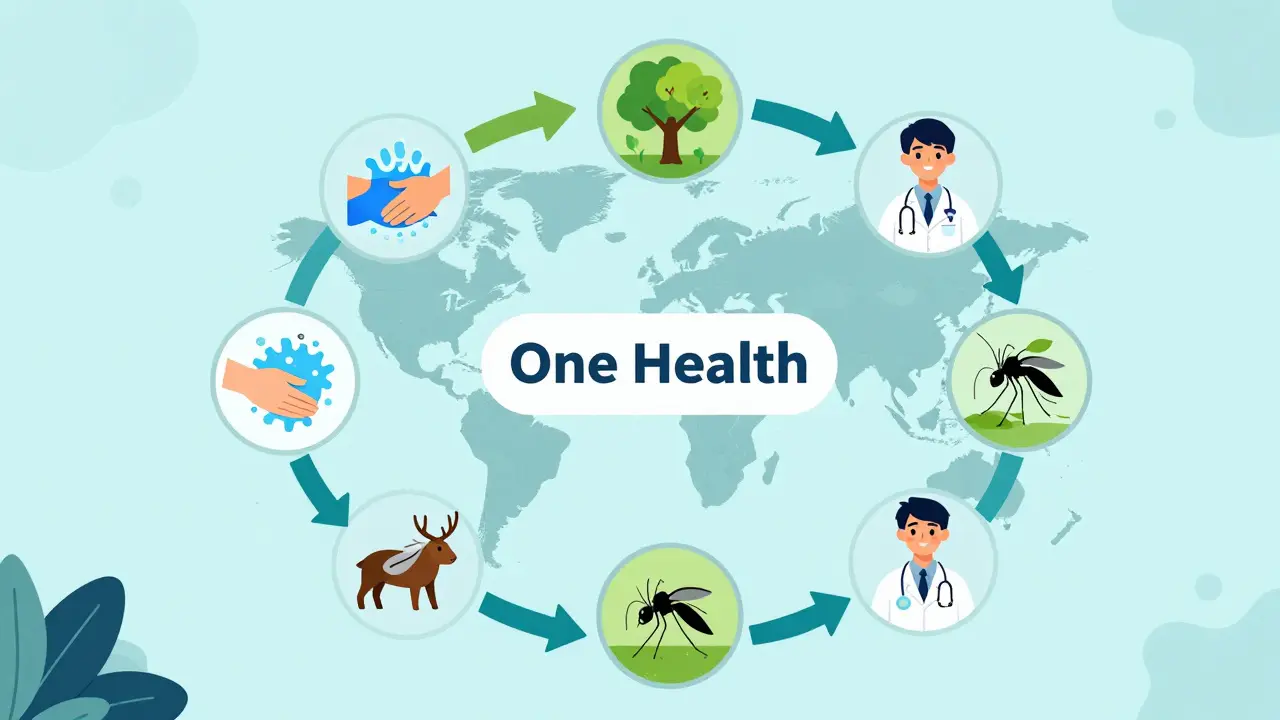
And it’s not just about medical gaps. Global coordination is weak. Only 38% of countries have functional systems that bring together human health, animal health, and environmental experts-the One Health approach. The WHO, FAO, and OIE call this the only way to truly stop outbreaks before they explode.
Who’s Most at Risk?
It’s not just the obvious groups. Yes, farmers, veterinarians, and wildlife workers are at higher risk. But the data shows something else: kids, pregnant women, and older adults are more likely to get seriously ill.
A family in Wisconsin got salmonella from pet turtles. The youngest child, age 2, ended up in the hospital with dehydration. That’s not unusual. Kids under five are 10 times more likely to be hospitalized after a zoonotic infection than adults. Their immune systems aren’t fully developed. They put things in their mouths. They hug animals without washing hands.
Pregnant women are at risk from toxoplasmosis, which can cause miscarriage or birth defects. It’s carried in cat feces. People think it’s about litter boxes-but you can get it from gardening in soil contaminated by infected cats, or eating unwashed vegetables.
And then there’s occupational risk. Veterinarians have 8 times the exposure risk of the average person. Agricultural workers get 5.2 zoonotic infections per 1,000 workers every year. That’s not a footnote-it’s a public health crisis in plain sight.
What Can You Actually Do to Protect Yourself?
Here’s the good news: You don’t need to give up pets or stop eating meat. You just need to change a few habits.
- Wash your hands. Seriously. Twenty seconds with soap and water reduces pathogen transmission by 90%. Do it after touching animals, handling pet food, cleaning litter boxes, or even just coming inside from the yard. Don’t skip it because you think you didn’t touch anything dirty. Germs travel on your clothes, your shoes, your phone.
- Cook meat properly. Chicken needs to hit 165°F. Ground beef? 160°F. Use a thermometer. Guessing doesn’t work. Salmonella and E. coli don’t care if you like your steak rare. They’re still alive.
- Wear gloves when cleaning up animal waste. A 2021 study in JAMA Internal Medicine showed gloves reduce exposure risk by 85%. That’s not optional for pet owners or gardeners.
- Don’t adopt wild animals as pets. Turtles, snakes, hedgehogs, and primates carry germs you can’t see. Pet stores sell them like toys. But the CDC has clear warnings: reptiles are linked to over 70,000 salmonella cases in the U.S. every year.
- Keep your pets vaccinated and checked. Rabies vaccines for dogs and cats save lives. Flea and tick prevention stops Lyme disease and other vector-borne illnesses. Ask your vet what’s needed for your area.
- Be smart outdoors. Tuck your pants into your socks when hiking. Use insect repellent with DEET. Check yourself for ticks after being in grassy or wooded areas. Remove them with tweezers-don’t burn or crush them.
And if you’re a parent: Don’t let kids under five touch reptiles, amphibians, or baby chicks. That’s a CDC recommendation for a reason.
What’s Being Done-And What’s Not
The world knows this is a growing threat. The Tripartite+ (WHO, FAO, OIE, UNEP) launched a $150 million plan in 2022 to build One Health systems in 100 countries by 2026. The CDC just pledged $25 million to set up university centers training doctors, vets, and environmental scientists together.
But money isn’t the only problem. It’s politics. In the U.S., there’s no national system for tracking zoonotic diseases from farm to hospital. In Europe, the Zoonoses Directive forces countries to monitor and report. Here? It’s a patchwork. Some states track everything. Others don’t even require reporting of rabies.
And then there’s the environment. Dr. Jane Goodall said it best: Our disrespect for wild animals and their habitats is creating the perfect conditions for disease jumps. Deforestation, wildlife trade, and factory farming are the top drivers. Land-use change causes 31% of emerging zoonotic outbreaks. That’s not an accident-it’s a choice.
Investing in prevention saves money. The World Bank says spending $10 billion a year on One Health programs could prevent 70% of future pandemics-and return $100 for every dollar spent. That’s not a cost. That’s the smartest insurance policy we’ve ever had.
What’s Next?
Climate change will make this worse. Warmer temperatures mean ticks and mosquitoes live longer and spread farther. Areas that were once too cold for Lyme disease are now hotspots. The Lancet predicts a 45% increase in suitable habitat for Lyme disease in North America by 2050.
Antibiotic resistance is another ticking bomb. The CDC reports 2.8 million antibiotic-resistant infections in the U.S. every year. About 20% of those come from animals. Overusing antibiotics in livestock is making superbugs that can’t be treated.
We’re not helpless. We just need to act like it matters. It’s not about fear. It’s about responsibility. Your pet isn’t just a companion-it’s part of a health system. Your food choices aren’t just personal-they’re public health decisions. Your vote, your voice, your habits-they all shape whether the next outbreak is contained… or becomes a global crisis.
Can you get sick from your pet dog or cat?
Yes. Common zoonotic diseases from pets include ringworm (a fungal infection), cat scratch disease (from scratches or bites), salmonella (from reptiles or birds), and toxoplasmosis (from cat feces). Dogs can carry leptospirosis and Lyme disease if they’re exposed to ticks. The risk is low if you practice good hygiene-wash hands after handling pets, clean litter boxes daily, and keep pets vaccinated and parasite-free.
Are all zoonotic diseases deadly?
No. Many are mild-like a short bout of diarrhea from salmonella or a skin rash from ringworm. But some are extremely dangerous. Rabies is almost always fatal once symptoms start. Ebola and Hantavirus have high death rates. The severity depends on the pathogen, your age, immune status, and how fast you get treatment. Don’t assume a mild symptom means it’s harmless.
Can you catch zoonotic diseases from wild animals?
Absolutely. Deer carry ticks that spread Lyme disease. Rodents carry hantavirus and leptospirosis. Bats are linked to rabies and Ebola. You don’t need to touch them-inhaling dust from their droppings, drinking contaminated water, or being bitten by an infected tick can be enough. Avoid feeding or approaching wild animals. Don’t camp near rodent burrows. Seal gaps in your home to keep them out.
Is it safe to eat meat and dairy?
Yes-if it’s handled and cooked properly. Pasteurized milk and properly cooked meat are safe. Raw milk, undercooked poultry, and rare ground beef carry risks. Always use a food thermometer. Wash cutting boards and knives after handling raw meat. Don’t rinse chicken-it spreads bacteria around your sink. Choose reputable suppliers and avoid products from unregulated sources.
What’s the difference between zoonotic and vector-borne diseases?
All vector-borne diseases are zoonotic, but not all zoonotic diseases are vector-borne. Vector-borne means an insect or tick carries the germ from animal to human-like Lyme disease via ticks. Zoonotic includes direct contact (pet bites), food (undercooked meat), water (contaminated lakes), and airborne particles (dust from animal droppings). So, rabies from a dog bite is zoonotic but not vector-borne. Malaria is vector-borne and zoonotic in some animal reservoirs, but primarily human-to-human in most cases.
Christina Widodo
January 11, 2026 AT 18:44My kid brought home a turtle from a school science fair and we didn’t think twice-until she got sick. Salmonella. Three days in the hospital. Now we know better. No more reptiles for under-fives. Simple rule, life-saving habit.
Alice Elanora Shepherd
January 12, 2026 AT 22:25Handwashing isn’t just for hospitals-it’s the first line of defense. Twenty seconds, soap, scrub under nails, rinse. It’s boring, but it works. I’ve been doing it since my vet told me about zoonotic risks. No drama. Just discipline.
gary ysturiz
January 14, 2026 AT 00:47You don’t need to be scared of your dog. You need to be smart. Vaccines, clean paws, wash hands after cuddles. That’s it. This isn’t a horror story-it’s a reminder to take simple steps. Small habits, big protection.
Jessica Bnouzalim
January 15, 2026 AT 21:44I used to think ringworm was just a kids’ thing… until I got it from my cat. It’s itchy, embarrassing, and lasts forever. Now I scrub my hands after petting her-even if she’s clean. And I vacuum more. Always. Seriously. Just do it.
Sumit Sharma
January 16, 2026 AT 14:35The data is clear: 68% of physicians lack training in zoonotic recognition. This is not negligence-it is systemic failure. The medical-industrial complex prioritizes reactive care over preventive ecology. One Health is not a buzzword-it is the only viable framework. Until we integrate veterinary, human, and environmental surveillance, we are merely delaying the next collapse.
Bryan Wolfe
January 17, 2026 AT 02:57Love your pets. Respect the germs. Wash your hands. Cook your meat. Don’t touch wild animals. These aren’t rules from a textbook-they’re the quiet armor of everyday life. You don’t need a degree to protect yourself. Just awareness and a little discipline.
Katherine Carlock
January 18, 2026 AT 19:33My grandma used to say, ‘Clean hands, clean soul.’ She didn’t know about zoonotic diseases, but she knew hygiene. Now I teach my kids the same thing. No petting turtles. No licking spoons after raw meat. Simple. No drama. Just care.
Amanda Eichstaedt
January 19, 2026 AT 23:59It’s wild how we treat animals like decorations until they make us sick. We buy hedgehogs like they’re plush toys. We let kids kiss puppies without washing up. We ignore the fact that nature doesn’t care if we’re cute or busy. The real tragedy isn’t the disease-it’s that we refuse to see ourselves as part of the ecosystem, not above it.
laura manning
January 20, 2026 AT 22:26According to the CDC’s 2022 surveillance data, reptile-associated salmonellosis accounts for approximately 74,000 reported cases annually in the United States, with a disproportionate incidence among pediatric populations under five years of age. Furthermore, the underreporting bias is estimated at 38.7%, suggesting actual incidence may exceed 120,000 cases per year. This is not anecdotal-it is a quantifiable public health burden requiring regulatory intervention.
Jay Powers
January 21, 2026 AT 20:05People think pets are safe because they’re cuddly. But germs don’t care how soft your cat is. I had a friend who got toxoplasmosis from gardening. She didn’t even own a cat. Just a dirty shovel and a careless mindset. Wash your hands. Always. Even if you think you didn’t touch anything.
Eileen Reilly
January 21, 2026 AT 23:48so like… why are we even talking about this like its new? we’ve been eating meat and touching animals for 10k years. now suddenly its a crisis because some rich people got scared of a virus? chill. your dog isnt gonna kill you. wash your hands if you’re paranoid. but stop acting like every pet is a biohazard.
Lawrence Jung
January 23, 2026 AT 09:30The real issue isn’t zoonotic disease-it’s human arrogance. We think we’ve tamed nature. We breed animals in cages, clear forests, and treat pets like accessories. Then we act shocked when nature bites back. The solution isn’t better handwashing. It’s humility. We’re not the masters of this planet. We’re just one species trying not to die from the consequences of our own ignorance.
Prachi Chauhan
January 24, 2026 AT 14:16My uncle in rural India got leptospirosis from walking barefoot in flooded fields after monsoon rains. He didn’t know what it was. Took him months to recover. We don’t need fancy labs to understand this. When animals and people share space, germs share it too. Clean water. Boots. Respect. That’s all it takes.