
Thyroid Medications: Levothyroxine Safety and Monitoring
 Nov, 29 2025
Levothyroxine is one of the most commonly prescribed medications in the UK and the US. Millions of people take it every day to manage hypothyroidism - a condition where the thyroid doesn’t make enough hormone. It’s simple, effective, and usually safe. But levothyroxine isn’t a pill you can take and forget. Get the dose wrong, switch brands without telling your doctor, or skip blood tests, and things can go sideways fast.
Why Levothyroxine Works - and Why It’s Tricky
Levothyroxine is a synthetic version of T4, the main hormone your thyroid makes. When your thyroid fails, your body slows down. You feel tired, gain weight, get cold easily, and your mind feels foggy. Levothyroxine replaces what’s missing. For most people, it brings life back to normal.
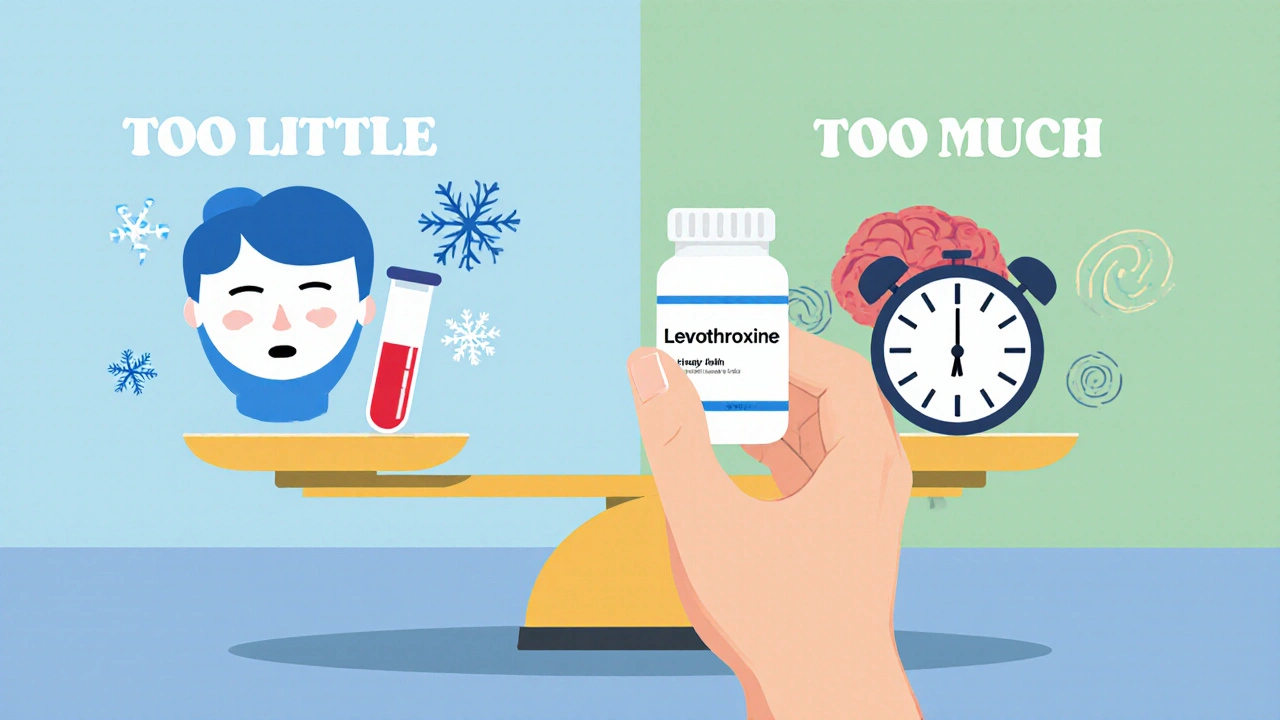
But here’s the catch: thyroid hormones affect everything - your heart, your bones, your mood, your metabolism. Too little and you stay hypothyroid. Too much and you risk heart palpitations, bone loss, anxiety, or even atrial fibrillation. The window between right and too much is narrow. That’s why monitoring isn’t optional. It’s essential.
How Often Should You Get Tested?
When you start levothyroxine, your doctor should check your TSH (thyroid stimulating hormone) level after 6 weeks. That’s not a suggestion - it’s the standard. Why? Because it takes about 4-6 weeks for your body to fully adjust to a new dose. Testing too early gives you misleading numbers.
Once you’re stable - meaning two TSH tests, 3 months apart, are both in range - you can usually drop to once a year. But here’s where things fall apart in real life. NHS data shows only 58% of primary care practices stick to this schedule. Over a third of patients go more than 18 months without a single blood test. That’s dangerous.
Some people need more frequent checks:
- Pregnant women - every 4-6 weeks in the first half of pregnancy
- People over 65 - especially if they have heart disease
- Those on lithium or amiodarone - these drugs interfere with thyroid function
- Anyone who’s had a dose change - even a 12.5 mcg tweak needs retesting in 6 weeks
And don’t assume your symptoms are just ‘aging’. Fatigue, weight gain, or brain fog after years on levothyroxine? That’s not normal. It’s probably your dose.
The Brand Switch Problem
Most people get levothyroxine as a generic. That’s fine - and cheaper. But here’s what many don’t know: different brands, even with the same dose, can behave differently in your body.
The UK’s MHRA reviewed over 300 reports between 2015 and 2019 where patients had problems after switching brands. Symptoms? Fatigue (78%), headaches (65%), anxiety (47%), palpitations (39%). In 9 cases, blood tests showed they were under-treated. In 4, they were over-treated. The rest? No one checked.
On patient forums like Thyroid UK, 68% of 1,245 respondents said they had bad reactions after a pharmacy switched their pill without telling them. One woman on Reddit described going from feeling fine to having panic attacks and a racing heart after her pharmacist gave her a different generic. Her doctor didn’t test her for 10 months.
If you’ve ever had symptoms after a refill change, ask your doctor to prescribe by brand name. The MHRA now advises this for patients who’ve had problems. Don’t let your pharmacy swap it without your consent.

What You Need to Know About Taking It
Levothyroxine isn’t like a multivitamin you can swallow with coffee. It needs space.
Take it on an empty stomach, at least 30-60 minutes before breakfast. Coffee, calcium, iron, antacids, and even soy milk can block absorption. If you take any of these, space them out by at least 4 hours.
Here’s what to avoid within 4 hours of your pill:
- Calcium supplements
- Iron tablets
- Antacids with aluminum or magnesium
- Cholesterol meds like cholestyramine
- Soymilk and high-fiber foods
Some people take it at bedtime instead - and that works too, as long as it’s at least 3-4 hours after your last meal. Consistency matters more than the time of day.
Who Needs a Specialist?
Most people do fine with their GP. But some need an endocrinologist:
- Children under 16
- Pregnant or postpartum women
- People with pituitary disease
- Those with heart disease, especially if over 65
- Anyone on amiodarone or lithium
- Patients with thyroid cancer on suppressive therapy
If your TSH keeps drifting out of range despite dose changes, or you still feel awful even with normal numbers, ask for a referral. You’re not being difficult. You’re being smart.

What If You Still Don’t Feel Right?
Here’s a hard truth: 15-20% of people on levothyroxine need dose changes every year. Why? Your body changes. You gain weight. You get older. You start or stop another drug. You become pregnant. Your thyroid tissue might still be slowly dying.
Some people report ongoing fatigue, depression, or brain fog even with a "normal" TSH. That’s real. The American Thyroid Association is looking into whether adding T3 (liothyronine) helps these patients. Right now, it’s not standard - but it’s being studied.
Don’t settle. If you’re still struggling, ask for a full thyroid panel: TSH, Free T4, Free T3, and thyroid antibodies. Sometimes the problem isn’t the dose - it’s how your body converts T4 to T3.
What’s Changing in 2025?
Guidelines are evolving. The American Thyroid Association now says TSH targets shouldn’t be one-size-fits-all. For someone over 70 with heart disease, a TSH of 5.5-7.5 might be safer than forcing it down to 2.0.
Research at the Mayo Clinic is exploring genetic testing to predict how someone metabolizes levothyroxine. Early results suggest up to 23% of dose differences between people come from genetics. That could mean personalized dosing in the future.
For now, stick to the basics: take it right, get tested regularly, don’t switch brands without telling your doctor, and speak up if something feels off.
Final Reality Check
Levothyroxine is one of the most effective drugs in medicine. But it’s not harmless. It’s powerful. And it demands attention.
Don’t let a busy GP, a pharmacy substitution, or a skipped blood test become the reason you still feel tired. You deserve to feel better. That means being your own advocate. Keep a log of your symptoms. Bring your test results to appointments. Ask: "Is my dose still right?"
Thousands of people live full, energetic lives on levothyroxine. But they’re the ones who stayed on top of their care - not the ones who assumed it was "set and forget."
Can I stop taking levothyroxine if I feel better?
No. Hypothyroidism is usually a lifelong condition. Stopping levothyroxine will bring your symptoms back - often worse than before. Even if you feel fine, your body still needs the hormone. Only stop if your doctor tells you to - and even then, it’s usually because your thyroid has recovered, which is rare.
Why do I need blood tests if I feel fine?
Because how you feel doesn’t always match your hormone levels. You could be slightly over-dosed and not notice - until your heart starts racing or your bones weaken. Or you could be under-dosed and think it’s just stress. Blood tests are the only way to know for sure. Annual checks are the minimum.
Is generic levothyroxine safe?
Yes - for most people. All generic versions must meet strict bioequivalence standards. But some patients are sensitive to tiny differences in fillers or absorption. If you’ve had symptoms after switching brands, ask your doctor to prescribe by brand name. Your health is worth the extra cost if it keeps you feeling well.
Can I take levothyroxine with other medications?
Some can interfere. Calcium, iron, antacids, cholesterol drugs, and even soy products can block absorption. Take levothyroxine alone, 30-60 minutes before food or other meds. If you take supplements, space them 4 hours apart. Always tell your doctor or pharmacist about everything you’re taking.
What if my TSH is normal but I still have symptoms?
Ask for a full thyroid panel: Free T4, Free T3, and thyroid antibodies. Sometimes the issue isn’t TSH - it’s how your body converts T4 to T3, or you have an autoimmune condition like Hashimoto’s still active. Don’t accept "it’s all in your head." Push for more tests. Your symptoms matter.
Does levothyroxine cause weight gain?
No - not when dosed correctly. In fact, untreated hypothyroidism causes weight gain. If you’re gaining weight on levothyroxine, your dose may be too low, or something else is going on - like insulin resistance, stress, or lack of sleep. Don’t blame the pill. Get your levels checked and look at the bigger picture.
Joy Aniekwe
November 30, 2025 AT 02:06Oh wow, another article that treats patients like dumb robots who can’t possibly know their own bodies. Let me guess - the next thing you’ll say is ‘just trust your GP’? Meanwhile, I’ve been on levothyroxine for 12 years and my TSH has never matched how I actually feel. But sure, let’s ignore the 68% of people on Thyroid UK who reported disasters after pharmacy switches. Because why listen to lived experience when you’ve got a textbook?
Latika Gupta
December 1, 2025 AT 02:59I switched brands last year without knowing. Started having panic attacks at 3am. I thought it was stress. Then I found out my pharmacy changed it. I cried for two hours. I didn’t tell anyone because I thought I was being dramatic. Now I always check the label. Always. Please, if you feel weird after a refill - don’t ignore it. It’s not in your head.
Sullivan Lauer
December 2, 2025 AT 17:41Let me tell you something - this isn’t just about thyroid meds, this is about the entire broken healthcare system in both the US and UK. We treat chronic conditions like they’re software updates - install, reboot, done. But your body isn’t a smartphone. It’s a living, breathing, hormone-swinging miracle machine that needs constant tuning. I’ve seen patients go from walking into the clinic with energy to barely able to lift their head because no one checked their labs in 18 months. And when they finally do? Their TSH is off the charts. It’s not negligence - it’s systemic neglect. We need mandatory annual testing protocols enforced by law. Not suggestions. Laws. Because people are dying quietly while their doctors are too busy to care.
Sohini Majumder
December 3, 2025 AT 07:41OMG I can’t even… like, I took my pill with coffee once and I swear I turned into a human tornado. Like, heart racing, hands shaking, crying over a meme about cats?? I thought I was having a breakdown. Turns out? My body hates caffeine within 4 hours of T4. Also, my pharmacist gave me a different pill last month and I thought I was going insane. I called my doctor and she said ‘oh that’s fine’ - NO IT’S NOT FINE. I NEED MY BRAND. I NEED MY PEACE. I NEED MY LIFE BACK. #ThyroidWarrior
tushar makwana
December 4, 2025 AT 05:29i think this is very important. i know people who feel bad and think it’s just aging. but maybe it’s their dose. i have a cousin in delhi - she was tired all the time, gained weight, thought it was stress. then she got tested. her tsh was 8.5. after changing dose, she started walking again. no magic. just science. please, if you feel off - get tested. it’s not weak. it’s smart.
Richard Thomas
December 6, 2025 AT 02:15While the clinical guidelines referenced are generally sound, the implicit assumption that TSH normalization equates to clinical well-being is both reductive and potentially hazardous. The literature increasingly suggests that a subset of patients exhibit suboptimal conversion of T4 to T3, a phenomenon inadequately addressed by current paradigms. Moreover, the bioequivalence standards for generic formulations, while statistically valid at a population level, fail to account for interindividual pharmacokinetic variance - particularly in elderly patients with comorbidities. A more nuanced, individualized approach to dosing and monitoring is not merely desirable - it is an ethical imperative.
Steven Howell
December 6, 2025 AT 21:45One thing I’ve learned working in endocrinology for 20 years: the people who do best on levothyroxine are the ones who keep logs. Not just TSH numbers - but sleep quality, energy levels, mood, weight trends. I had a patient who noticed her anxiety spiked every time her pill was switched. She brought me her notebook. We switched to a branded version. Her life changed. You don’t need to be a doctor to be your own best advocate. Just be consistent. Be observant. Be loud when something’s off.
Robert Bashaw
December 8, 2025 AT 04:49Levothyroxine isn’t a vitamin - it’s a nuclear reactor wrapped in a tiny white pill. One wrong move and you’re not just tired - you’re a human who’s been set on fire and told to ‘just breathe’. I once took a new batch and felt like my bones were vibrating. My heart was doing the cha-cha in my chest. I thought I was dying. Turned out? Pharmacy swapped my brand. I didn’t know. My doctor didn’t test me for 10 months. I almost quit my job. I almost quit life. Don’t be that person. Check your pills. Ask questions. Demand your blood work. Your life isn’t a spreadsheet.
Brandy Johnson
December 10, 2025 AT 01:30It’s laughable that Americans are being told to demand brand-name levothyroxine. In the UK, we’ve had generic substitution for decades - and our NHS is far more efficient. If you can’t handle a minor formulation difference, perhaps you shouldn’t be managing your own chronic condition. This is what happens when patients are coddled instead of educated. Stop whining. Trust the science. Trust the system.
Monica Lindsey
December 11, 2025 AT 05:06You’re all just lazy. If you don’t feel right, you didn’t take it right. Coffee. Food. Calcium. You messed up. Stop blaming the pill. Stop blaming the pharmacy. Stop blaming your doctor. Take it on an empty stomach. Every. Single. Day. No excuses. You’re not special. Your thyroid doesn’t care how you feel. Your TSH does. Get tested. Do the math. Shut up and take your pill.