
Metformin and Kidney Function: How to Monitor and Adjust Doses Safely
 Jan, 6 2026
Metformin is the most common pill prescribed for type 2 diabetes. It’s cheap, effective, and reduces the risk of heart attacks. But if your kidneys aren’t working well, doctors used to tell you to stop taking it. That’s changed. Today, you can still take metformin even with mild to moderate kidney issues - if you monitor correctly. The key isn’t avoiding metformin. It’s knowing when and how to adjust it.
Why Kidney Function Matters for Metformin
Metformin doesn’t get broken down by your liver. It leaves your body through your kidneys. If your kidneys slow down, metformin builds up. Too much can lead to lactic acidosis - a rare but serious condition where acid builds up in your blood. But here’s the truth: metformin itself doesn’t cause kidney damage. It just needs your kidneys to clear it out. Many patients stop taking it because they’re scared it’s hurting their kidneys. That’s a myth. A 2022 review found 22% of patients with healthy kidneys stopped metformin just because their eGFR dropped - even when it was still safe to use.
eGFR: The New Number That Matters
Doctors don’t use creatinine levels anymore to decide if you can take metformin. They use eGFR - estimated glomerular filtration rate. This number estimates how well your kidneys filter waste. It’s calculated from your age, sex, race, and blood creatinine. It’s more accurate than old methods.
Here’s how eGFR guides dosing as of 2026:
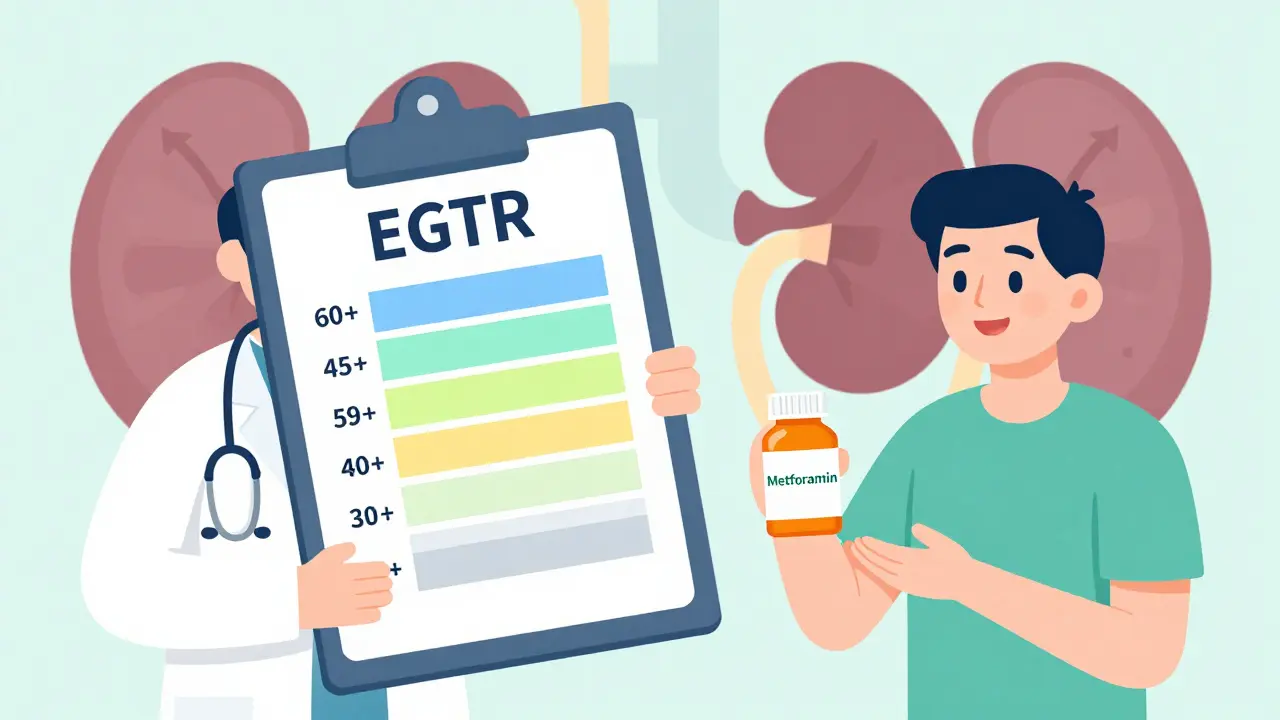
- eGFR 60 or higher: You can take up to 2,550 mg per day. Get your eGFR checked every 6 to 12 months.
- eGFR 45-59: Max dose is 2,000 mg per day. Check eGFR every 3 to 6 months.
- eGFR 30-44: Max dose is 1,000 mg per day. Monitor every 3 months. Don’t start metformin here if you’ve never taken it before - but if you’re already on it and stable, keep going with your doctor’s approval.
- eGFR below 30: Metformin is generally not recommended. Some experts may use 500 mg daily in very stable patients, but this is rare and requires close supervision.
These guidelines come from the FDA, ADA, and NICE. They’re based on data showing lactic acidosis is extremely rare - only about 3.3 cases per 100,000 patient-years. Most cases happen when someone has another serious illness, like a heart attack or infection, not because of metformin alone.
Different Guidelines, Same Goal
Not all guidelines agree on every detail. The FDA says don’t start metformin if your eGFR is between 30 and 44. But the American Association of Clinical Endocrinology says you can reduce the dose and keep going. NICE says review the dose whenever eGFR falls below 45. And KDIGO - the kidney specialist group - says metformin is safe above eGFR 45 unless you’re at risk for sudden kidney injury.
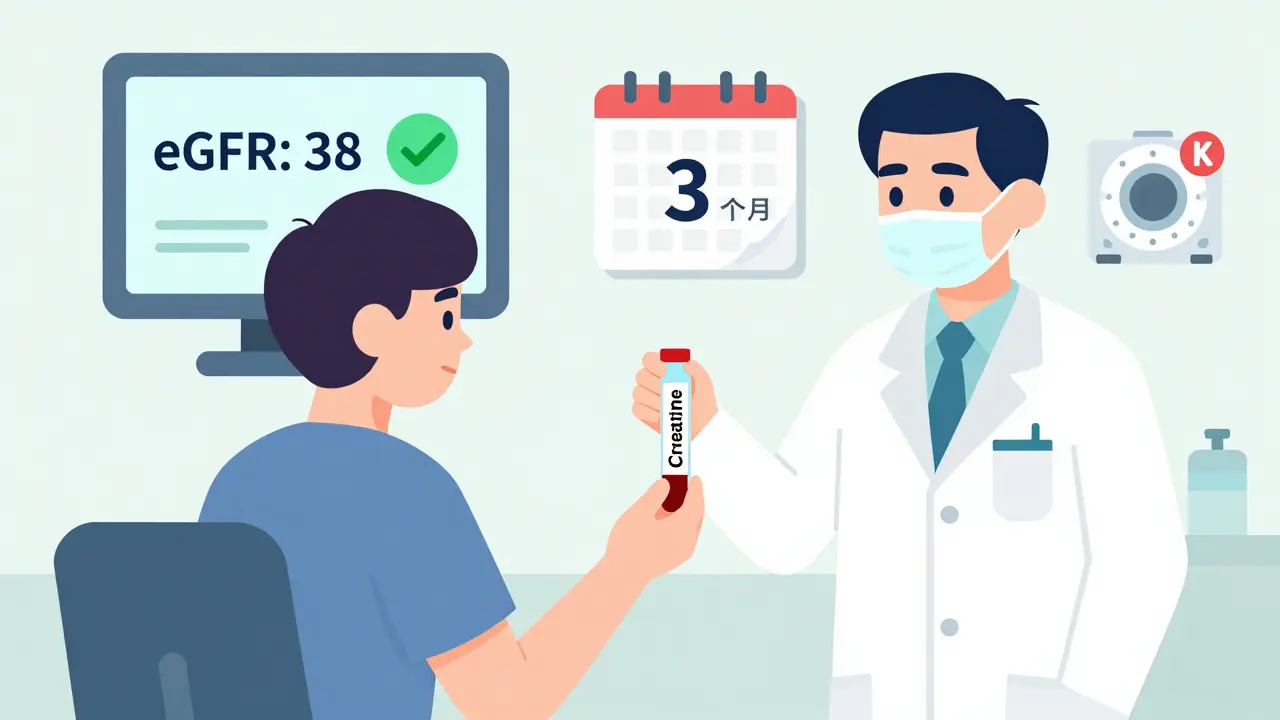
What does this mean for you? It means your doctor needs to think about more than just a number. Are you stable? Do you have other health problems? Are you drinking enough water? Are you on other meds that can hurt your kidneys? A 72-year-old with stable eGFR of 38 and no other issues might do fine on 1,000 mg. A 68-year-old with heart failure and dehydration might need to pause it.
Special Cases: Dialysis and Contrast Dyes
If you’re on dialysis, metformin dosing changes. For peritoneal dialysis, 250 mg daily is typical. For hemodialysis, take 500 mg right after your session. The dialysis removes the drug, so you need to replace it.
And if you’re getting a CT scan with contrast dye? That’s a red flag. Contrast can cause sudden kidney stress. If your eGFR is under 60, your doctor will likely tell you to skip metformin for 48 hours before and after the scan. Restart only after your kidney function is checked again. This isn’t about metformin being dangerous - it’s about protecting your kidneys during a temporary risk.
What Else Should You Watch For?
Metformin can lower vitamin B12 levels over time. After 4-5 years on the drug, about 7-10% of people develop a deficiency. That can cause fatigue, numbness, or even memory problems. Get your B12 checked every 2-3 years if you’ve been on metformin long-term.
Also, avoid NSAIDs like ibuprofen or naproxen if your eGFR is between 30 and 59. These drugs can drop your kidney function quickly. Tylenol (acetaminophen) is safer for pain relief in this group.
And yes - metformin can cause stomach upset. Diarrhea, nausea, gas. That’s why many doctors start at 500 mg a day and slowly increase by 500 mg each week. One clinic in Cleveland cut patient dropouts by 68% just by slowing the ramp-up. You don’t have to take the full dose right away.
What Happens If You Stop Metformin?
Stopping metformin because your eGFR dropped to 40 is one of the biggest mistakes in diabetes care. A Reddit post from a doctor in 2023 shared a case: an 82-year-old patient had HbA1c at 6.8% on metformin. After stopping it due to eGFR 38, her HbA1c jumped to 8.9% in three months. That’s not just a number - it’s higher risk for nerve damage, vision loss, kidney failure.
Metformin doesn’t just lower blood sugar. It lowers heart attack risk by 32% over 10 years, according to the landmark UKPDS trial. That benefit doesn’t disappear just because your kidneys slow down. The goal is to keep you on it safely, not off it completely.
How to Stay on Track
Here’s a simple plan:
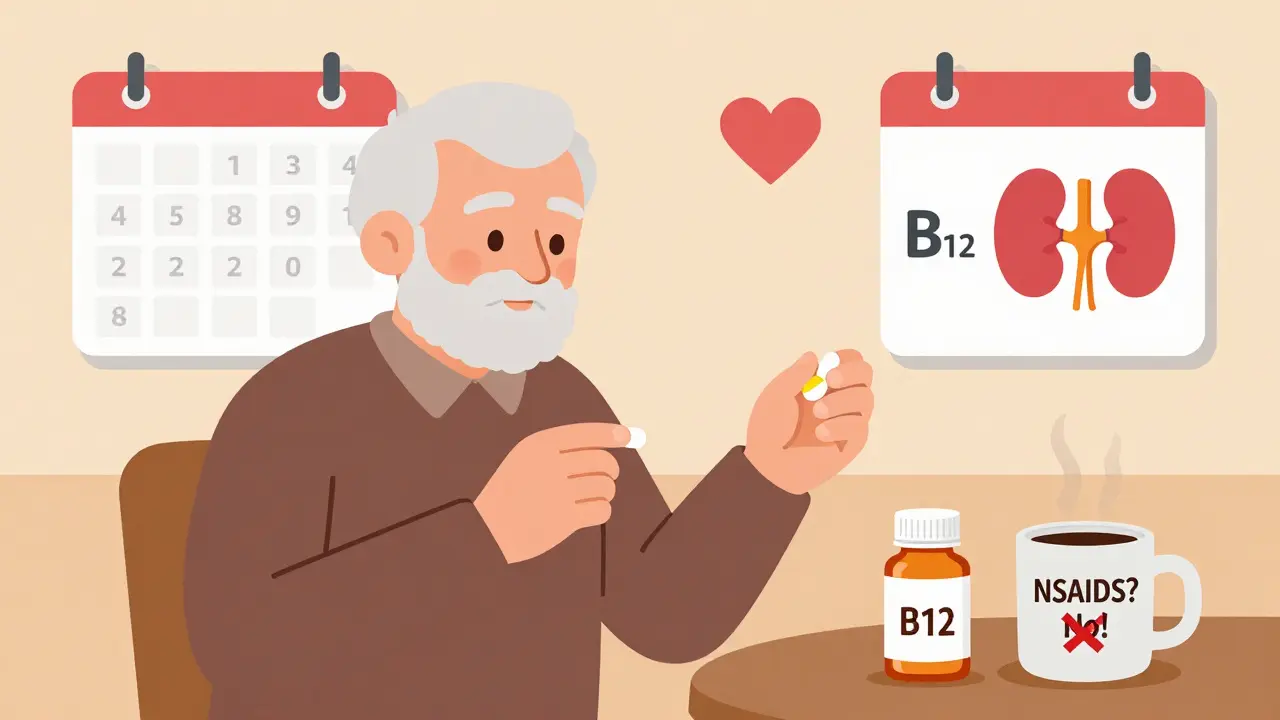
- Get your eGFR checked every 3-6 months if you’re on metformin and your eGFR is under 60.
- Ask your doctor to review your dose every time your eGFR changes.
- If you’re over 60 or have other health issues, ask about B12 levels.
- Never take NSAIDs without checking with your doctor if your eGFR is below 60.
- Hold metformin 48 hours before and after any CT scan with contrast.
- Don’t stop metformin just because your eGFR dropped - talk to your doctor first.
Some clinics now use automated alerts in electronic records. When an eGFR result comes in below 45, the system flags the patient and reminds the doctor to review metformin. That’s the future. But until then, you need to be your own advocate.
What’s Next?
Research is moving beyond eGFR alone. New studies are looking at cystatin C - another blood marker that’s more accurate in older adults. The 2024 ADA guidelines might start recommending it. And the MET-FORMIN-CKD trial is tracking patients with eGFR 25-35 on low-dose metformin. Early results suggest it might be safer than we thought.
For now, the message is clear: metformin is still the best first-choice drug for type 2 diabetes - even with kidney disease. You just need to manage it right. Don’t let fear or outdated rules make you stop a medicine that’s keeping you healthy.
FAQ
Can metformin damage my kidneys?
No, metformin does not damage kidneys. It’s cleared by the kidneys, but it doesn’t harm them. Many people stop taking it because they think it’s causing kidney problems - but that’s a myth. In fact, keeping your blood sugar controlled with metformin helps protect your kidneys over time.
What should my eGFR be to safely take metformin?
You can take metformin if your eGFR is 30 or above. At eGFR 30-44, the max dose is 1,000 mg per day. At eGFR 45-59, you can take up to 2,000 mg. Above 60, you can go up to 2,550 mg. Below 30, it’s generally not recommended unless under strict supervision.
Do I need to stop metformin before a CT scan?
Yes, if your eGFR is below 60. Hold metformin 48 hours before and after a CT scan with contrast dye. This is to prevent contrast-induced kidney injury. Restart only after your doctor checks your kidney function again.
Can I take metformin if I’m on dialysis?
Yes, but the dose changes. For peritoneal dialysis, take 250 mg daily. For hemodialysis, take 500 mg after each session. The dialysis removes metformin, so you need to replace it. Always follow your nephrologist’s instructions.
Why do I need to check my B12 levels on metformin?
Long-term metformin use can lower vitamin B12 levels in 7-10% of people. Low B12 can cause fatigue, tingling in hands and feet, or memory issues. Get tested every 2-3 years if you’ve been on metformin for more than 4 years. If low, your doctor can prescribe supplements.
Is it safe to take metformin with high blood pressure meds?
Most blood pressure medications are safe with metformin. But avoid NSAIDs like ibuprofen or naproxen if your eGFR is below 60 - they can cause sudden kidney drops. ACE inhibitors and ARBs are fine and may even help protect your kidneys.
steve rumsford
January 8, 2026 AT 10:24Metformin saved my life after my diabetes diagnosis. I was scared to take it because of the kidney stuff, but my endo explained it all and now my eGFR is 48 and I’m on 1500mg. No issues. Don’t let fear make you stop what works.
LALITA KUDIYA
January 8, 2026 AT 11:45so many people panic when their eGFR drops but the real danger is stopping metformin and letting sugar run wild
Anastasia Novak
January 9, 2026 AT 04:36Oh please. The FDA guidelines are a joke. You think a 72-year-old with an eGFR of 38 should just quit metformin because some committee in Washington decided to be overly cautious? That’s not medicine, that’s liability-driven cowardice. I’ve seen patients crash into HbA1c levels over 9% after being yanked off metformin-then they end up in the ER with DKA. The real risk isn’t lactic acidosis-it’s uncontrolled hyperglycemia. And let’s not even get started on how many doctors still think creatinine is the gold standard. 🤦♀️
Poppy Newman
January 10, 2026 AT 02:35Just had my B12 checked last month-down to 180. My doctor said it was probably metformin. Started supplements and my brain fog lifted in 3 weeks. So glad I asked. This post should be mandatory reading for every diabetic over 50. 🙌
Anthony Capunong
January 12, 2026 AT 02:07Why are we trusting American guidelines? In the UK they’re way more aggressive about keeping people on metformin. We don’t just stop meds because a number dips. This is why American healthcare is so broken-overcautious, under-informed, and terrified of lawsuits. Stop letting fear dictate your treatment.
Ayodeji Williams
January 12, 2026 AT 17:22they said metformin was gonna kill me but my sugar was worse than my kidneys. now i’m on 1000mg and my hba1c is 6.2. who’s the real villain here? the pill or the doctors who scare you into quitting?
Kyle King
January 12, 2026 AT 19:32Did you know the FDA changed these guidelines because Big Pharma paid them off? Metformin is generic. They want you on newer, expensive drugs. The lactic acidosis risk is 0.0033%-less than getting struck by lightning. But if you stop metformin, you’re gonna get diabetic neuropathy, amputations, blindness… and they’ll sell you a $1000/month injection for it. Wake up.
Kamlesh Chauhan
January 13, 2026 AT 21:40why do people make this so complicated its just a pill you take and your kidneys do their job stop overthinking it
Jonathan Larson
January 15, 2026 AT 10:25It is imperative to underscore that the preservation of metformin therapy in the context of mild-to-moderate chronic kidney disease represents not merely a pharmacological adjustment, but a paradigmatic shift in the ethical imperative of patient-centered care. The historical practice of discontinuation, rooted in precautionary dogma rather than empirical evidence, has demonstrably resulted in iatrogenic harm through glycemic deterioration. The data, as cited, are unequivocal: the risk of lactic acidosis remains statistically negligible when compared to the unequivocal cardiovascular and microvascular benefits conferred by sustained metformin use. Therefore, the clinical responsibility lies not in withdrawal, but in vigilant, individualized monitoring.
Vince Nairn
January 16, 2026 AT 08:47so the doctor says 'don't stop metformin' but also says 'hold it before a CT scan' and 'check B12' and 'don't take ibuprofen'... honestly i'm just waiting for them to tell me not to breathe near a car exhaust
Mina Murray
January 17, 2026 AT 08:30you think you’re safe with metformin? what about the 2021 study linking it to gut microbiome destruction? and the fact that it’s been linked to higher Alzheimer’s rates in elderly patients? your doctor doesn’t tell you this because they’re paid by pharma. check your urine for ketones. if they’re high, you’re already damaged.
Christine Joy Chicano
January 17, 2026 AT 16:05I’ve been on metformin for 11 years. My eGFR is 41. I take 1000mg daily. My B12 is fine because I’ve been supplementing since year 5. I’ve never had a single GI issue because I started at 500mg and crept up slowly. I also avoid NSAIDs like the plague. I’m not just surviving-I’m thriving. This isn’t about fear. It’s about discipline. And honestly? If you’re too lazy to track your labs and adjust your habits, maybe you shouldn’t be on the drug at all.
Alex Danner
January 18, 2026 AT 09:05Just want to add: if you're on metformin and your eGFR is under 45, get a cystatin C test. It's way more accurate than creatinine-based eGFR in older adults. My doc didn't even know about it until I brought it up. Now my cystatin C says I'm fine, even though my eGFR says 'danger zone'. Don't let one number dictate your life.
Paul Mason
January 20, 2026 AT 05:43metformin is fine for kidneys if you drink water. i used to be scared but now i drink 3 liters a day and my numbers are perfect. simple as that