
International Patent Expiration: How Timelines Vary Around the World
 Dec, 5 2025
Most people think a patent lasts 20 years - and that’s mostly true. But if you’re managing a global product, launching a drug, or selling tech across borders, that 20-year clock doesn’t tick the same everywhere. The real story is messier, full of hidden deadlines, country-specific rules, and financial traps that can kill your patent before the 20 years are up - even if you did everything right.
There’s No Global Patent, Just a Global Standard
You can’t file one patent and have it protect you in 195 countries. That’s a myth. What exists instead is a common rule: almost every country follows the 20-year term from the filing date. This standard came from the TRIPS Agreement in 1995, signed by all 164 WTO members. Before that, the U.S. gave patents 17 years from the issue date, not the filing date. That meant two patents filed on the same day could expire years apart, depending on how long the patent office took to approve them.
Now, the clock starts ticking the moment you file your first application - whether it’s in Japan, Brazil, or Germany. But that’s just the starting line. What happens after that? That’s where things get complicated.
The PCT Isn’t a Patent - It’s a Delay Tool
If you file under the Patent Cooperation Treaty (PCT), you’re not getting an international patent. You’re buying time. The PCT lets you file one application that counts in 157 countries. But you still have to enter the national phase in each country - and you only have 30 or 31 months from your original filing date to do it. Miss that window, and you lose rights forever in most places.
For example, the U.S. gives you 30 months. Canada, China, and most of Europe give you 31. Japan lets you stretch it by two extra months if you explain why you’re late. The U.S. also allows a two-month extension if you pay a fee. These tiny differences matter. A company filing a drug patent in March 2020 has until September 2022 (30 months) to file in the U.S., but until October 2022 (31 months) in Canada. If they delay too long, they lose Canada - even if they’re fine in the U.S.
Patents Can Die Before 20 Years - Even If You Pay Nothing
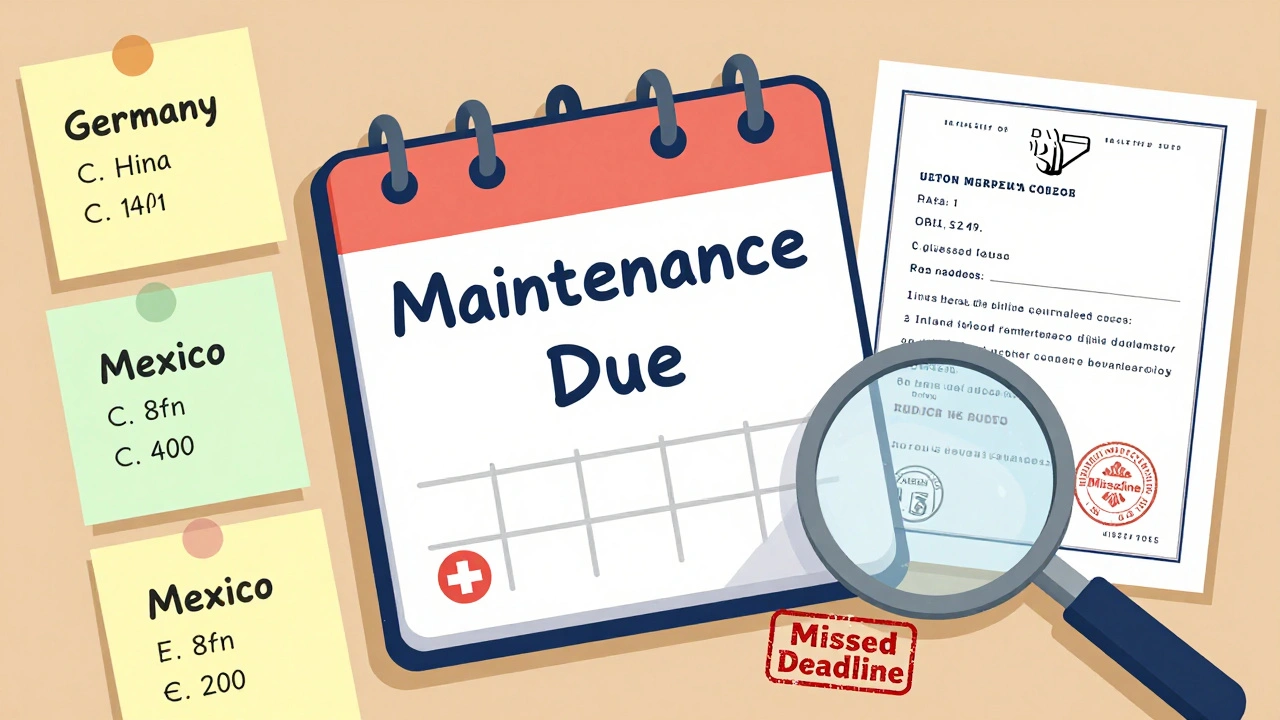
Patent expiration isn’t automatic. It’s conditional. Most countries require maintenance fees - payments made at set intervals to keep the patent alive. Skip one, and your patent dies. It doesn’t wait. It doesn’t warn you. It just ends.
In the U.S., you pay at 3.5, 7.5, and 11.5 years after grant. There’s a six-month grace period, but you pay a penalty. In Europe, you pay annually from year 3. In Mexico, you pay at years 5, 10, 15, and 20. Switzerland? Just one payment at grant. If you’re managing 50 patents across 10 countries, you’re tracking over 150 separate payment dates. One missed payment, and you lose rights in that country - even if your patent still has 10 years left.
This isn’t theoretical. In 2021, a mid-sized biotech firm lost patent protection for a key cancer drug in Brazil because their local agent missed the renewal deadline. The patent was still valid for 8 more years - but it was dead. No warning. No appeal.
Extensions Are the Wild Card - Especially for Drugs
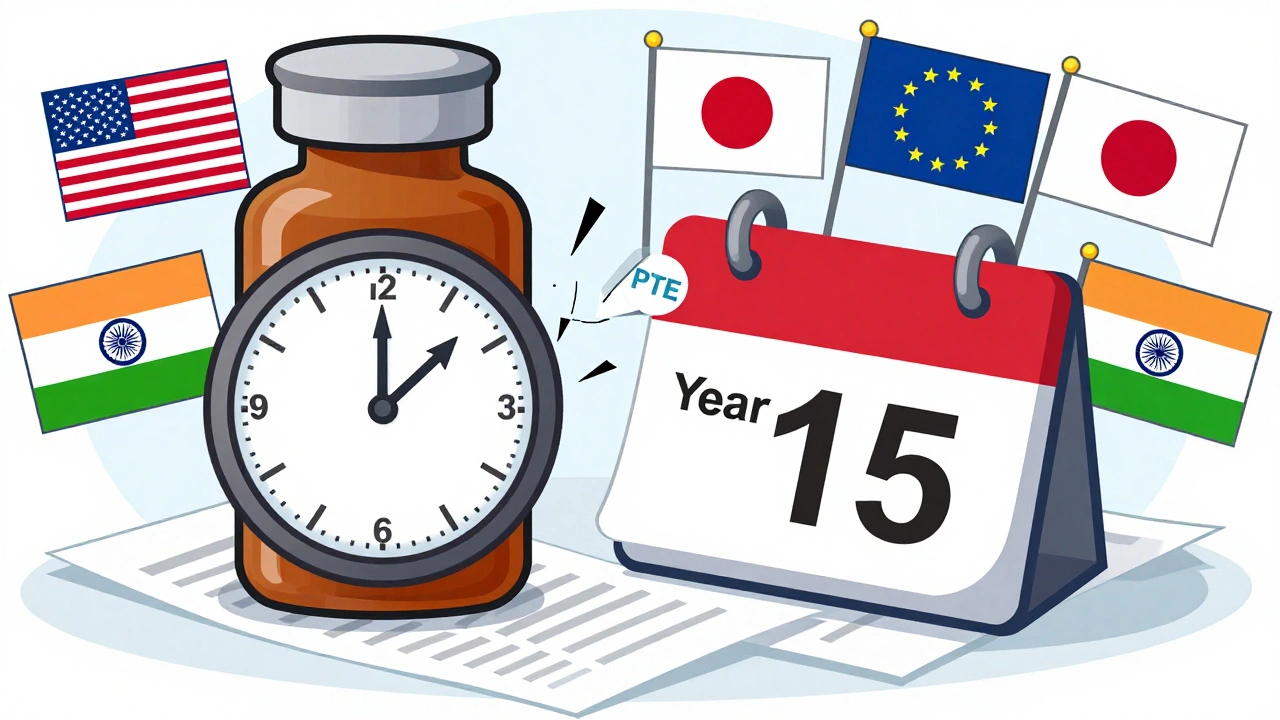
Patents for drugs don’t always expire after 20 years. Why? Because it can take 10 years just to get regulatory approval. By the time the drug hits the market, half the patent life is gone. That’s why many countries allow extensions.
The U.S. offers Patent Term Extensions (PTE) under the Hatch-Waxman Act. If the FDA delayed approval, you can get up to five extra years - but only for one product per patent, and only if you applied in time. The European Union does something similar with Supplementary Protection Certificates (SPCs). You can get up to five years added, plus six more months if you tested the drug on children.
But not everyone plays fair. India gives no extensions - ever. Australia gives extensions for patent office delays, but not for FDA-style delays. China introduced term compensation in 2021 for examination delays over three years. Japan allows extensions if the patent office took more than three years to examine the application.
For pharmaceutical companies, this isn’t just legal detail - it’s revenue. A drug that loses patent protection on day 7,000 (19.2 years) versus day 8,000 (21.9 years) can mean billions in lost sales. That’s why big firms like Pfizer and Johnson & Johnson have teams dedicated solely to tracking patent expiration dates across dozens of countries.
Utility Models: The Short-Lived Alternative
Not every invention needs a 20-year patent. Many countries offer utility models - simpler, faster, cheaper protections for mechanical or technical improvements. They’re not patents, but they’re still enforceable.
Germany, China, Japan, and South Korea all offer them. Terms? Usually 6 to 10 years. No substantive examination. Often no need for maintenance fees. They’re perfect for products with short lifecycles - think kitchen gadgets, phone accessories, or small machinery parts.
But here’s the catch: you can’t convert a utility model into a patent. And if you file a utility model in Germany, you can’t later file a patent in the U.S. for the same thing - unless you file the original application within 12 months under the Paris Convention. Miss that, and you’ve lost global rights.
What Happens When Countries Change the Rules?
Patent laws aren’t frozen in time. They evolve - and sometimes, they rewrite history.
Indonesia extended its patent term from 15 to 20 years in 2016. Vietnam did the same in 2022. Brazil still has a 20-year term on paper, but because its patent office has a backlog of over 130,000 pending applications, many patents only last 12 to 15 years in practice - because they’re approved so late.
The European Union’s Unitary Patent, launched in June 2023, doesn’t change the term - it’s still 20 years from filing. But it removes the need to validate the patent separately in 17 countries. One filing, one fee, one expiration date across the entire bloc. That’s a huge simplification - but only if you’re operating in those 17 countries.
Meanwhile, the U.S. continues to be the most complex system. You have to track provisional applications (which don’t count toward the 20-year term but set your priority date), continuation applications, terminal disclaimers, and multiple types of term adjustments. The average U.S. patent got 558 extra days of protection in 2022 due to USPTO delays - but that’s down from 612 days in 2021. Why? The USPTO improved its internal processes. That’s good for them - but bad for patent holders who expected longer terms.
Why This Matters for Your Business
If you’re launching a product internationally, you can’t treat patents like a checkbox. You need a timeline map for every market. For a medical device company, losing patent protection in Brazil because of a missed renewal fee could mean a competitor launches a copy - and you can’t stop them. For a software firm, a patent expiring in Japan because the PCT deadline was missed could mean losing the entire Asian market.
A 2021 study in the Journal of Intellectual Property Law & Practice found that for every one-year reduction in effective patent term, multinational pharmaceutical firms cut R&D spending by 3.2%. That’s not just legal risk - it’s financial risk. Investors notice when patent portfolios are poorly managed.
Even small companies can’t afford to guess. Tools exist to track global patent deadlines - but they’re only as good as the data you feed them. If your system doesn’t account for Japan’s two-month extension window or Mexico’s four payment dates, you’re flying blind.
What You Can Do Today
- Know your priority date - it’s your anchor for every other deadline.
- Map out national phase entry dates for each country you care about - don’t assume they’re all 30 months.
- Set up automated reminders for maintenance fees - with alerts for grace periods and penalties.
- For drugs or regulated products, track PTE/SPC eligibility in every market - and apply early.
- Consider utility models for fast-moving products - they’re cheaper and faster, even if they don’t last as long.
Patents are not just legal documents. They’re financial assets. And like any asset, they need active management. The 20-year rule is the headline. The real story is in the fine print - and the missed payments, the missed deadlines, the overlooked extensions. Get those right, and your innovation lasts. Miss them, and your patent dies - even if the calendar says it shouldn’t.
Do all countries have a 20-year patent term?
Almost all do - 164 countries that are part of the WTO follow the 20-year standard from the filing date. But there are exceptions. Brazil and some other countries have longer backlogs, so patents may only last 12-15 years in practice. Utility models in countries like Germany and China last only 6-10 years. And some countries, like India, offer no extensions even if regulatory approval takes years.
Can a patent expire before 20 years?
Yes - and it happens often. If you miss a maintenance fee payment, your patent expires immediately. This is true in the U.S., Europe, Japan, and most other countries. Even if you have 15 years left on the clock, one missed payment kills the patent. Many companies lose protection this way because they rely on local agents who don’t send reminders.
What’s the difference between filing date and issue date?
Before 1995, the U.S. used the issue date - the day the patent was granted - to calculate expiration. That meant two patents filed on the same day could expire years apart. Now, almost everywhere, the clock starts on the filing date - the day you submit your application. This makes terms more predictable internationally. But in the U.S., patents filed before June 8, 1995, still follow the old rule: expiration is the later of 20 years from filing or 17 years from issue.
Does the PCT extend the patent term?
No. The PCT only gives you time to decide where to file. It delays national phase entry by 30 or 31 months - but it doesn’t add time to the patent term. Your 20-year clock still starts on your original filing date. The PCT is a delay tool, not an extension tool.
Why do drug patents often last longer than 20 years?
They don’t - but they can be extended. Because it takes 8-12 years to get regulatory approval, the actual market time is short. The U.S. and EU offer Patent Term Extensions (PTE) or Supplementary Protection Certificates (SPC), adding up to 5 extra years. Japan and China now allow extensions for examination delays. But these are not automatic. You must apply, prove delays, and meet strict conditions. In countries like India, no extensions are allowed - so drug patents there expire exactly at 20 years, even if the product only hit the market at year 15.
How do I know when my patent expires in each country?
Start with your priority date. Then add 20 years. That’s your baseline. Next, check each country’s rules: Are there extensions? What are the maintenance fee dates? What’s the national phase deadline? Use a professional patent management system or hire a firm that specializes in global patent lifecycle tracking. Don’t rely on spreadsheets or manual tracking - the margin for error is too high.
Myles White
December 6, 2025 AT 09:18Man, I spent six months just tracking maintenance fees across 12 countries last year. One missed payment in Brazil killed a patent we’d spent $200k developing. No warning, no grace, just gone. I now use a SaaS tool that auto-syncs with WIPO and local patent offices - it’s expensive but cheaper than litigation. And yeah, Japan’s two-month extension? That saved us twice. Always check local nuances - the PCT is just the starting line, not the finish.
Also, utility models in Germany? Absolute lifesaver for hardware startups. We filed a utility model for our smart thermostat housing - 8 years, $300, no exam. Then we filed the real patent for the chip inside. Worked like a charm. Don’t treat all IP the same.
And for god’s sake, don’t trust your local agent’s email reminders. I had one guy miss a payment because his Gmail flagged it as spam. Set up your own calendar alerts. Triple-layered. Google, Outlook, and a physical sticky note on your monitor.
Patents aren’t paperwork. They’re financial instruments. Treat them like stock options - because if you blow them, your investors will fire you faster than a bad quarterly report.
Ibrahim Yakubu
December 7, 2025 AT 00:20Let me tell you something nobody wants to admit - the entire global patent system is a rigged casino designed to keep Big Pharma and Silicon Valley giants in power. The ‘20-year rule’? A myth sold to small inventors so they’ll keep paying renewal fees while the big players buy up loopholes.
Did you know the USPTO quietly extended patent terms for Apple and Qualcomm by over 7 years each between 2018–2023 through ‘examination delays’ claims? Meanwhile, a single mom in Lagos who invented a water purifier got her patent rejected because her application was ‘incomplete’ - even though she submitted everything the website said to submit.
This isn’t innovation protection. It’s wealth extraction disguised as law. And the ‘utility model’ loophole? That’s just a way for corporations to patent trivial shit like ‘a phone case with a built-in selfie stick’ while crushing real innovation.
Wake up. The system doesn’t care about you. It cares about shareholders. And if you’re not on the inside, you’re just fuel for the machine.
Chris Park
December 8, 2025 AT 08:47Actually, you’re all wrong. The TRIPS Agreement doesn’t mandate 20-year terms - it mandates minimum standards, and countries can exceed them. Brazil’s 12–15-year effective term isn’t due to backlog - it’s because their patent office intentionally delays grants to favor local generics. That’s state-sanctioned theft.
And the ‘PCT extension’ myth? It’s not just misleading - it’s fraudulent. The PCT is a front for multinational law firms to charge triple fees under the guise of ‘international filing.’ You don’t need it. File directly in the U.S., EU, and China - 80% of your revenue comes from those three.
Also, India doesn’t allow extensions? Correct. Because they’re not trying to protect innovation - they’re trying to destroy it. The entire Indian patent regime is a weaponized tool of economic colonialism disguised as access to medicine. Don’t be fooled by the ‘affordable drugs’ narrative. It’s a smokescreen for IP theft.
And yes, I’ve audited 47 patent portfolios across 18 jurisdictions. I know what I’m talking about. Your spreadsheets are useless. You need blockchain-based timestamping. And you need to sue the USPTO for misrepresenting term adjustments.
Jackie Petersen
December 8, 2025 AT 18:44U.S. patents are the only real ones. Everything else is just paperwork for people who don’t understand capitalism. Why should I care about Brazil or India? If they want to copy our tech, let them. We’ll just make the next thing faster and better. Patent law is for losers who think protection = success.
Also, why are we even talking about this? We have real problems - inflation, border security, school shootings. Patents? Please. Let the corporations fight over their legal toys while we live our lives.
Annie Gardiner
December 9, 2025 AT 21:48It’s funny how we treat patents like they’re sacred - like they’re the reason innovation exists. But what if they’re the opposite? What if patents are the chains we put on our own creativity? We spend billions defending 20-year monopolies while real progress happens in open-source communities, garage hackers, and decentralized labs.
I mean - look at Linux. No patents. Billions in value. Or CRISPR - patented, sure, but the science came from a university lab that didn’t care about royalties. What if we stopped treating knowledge like property and started treating it like air?
Don’t get me wrong - I get why companies do it. Fear. Control. Greed. But that doesn’t make it right. Maybe the real question isn’t ‘how do we extend patents?’ - but ‘how do we unshackle innovation?’
Kumar Shubhranshu
December 11, 2025 AT 20:35Ashish Vazirani
December 12, 2025 AT 03:21Let me tell you what really happens behind closed doors - patent offices in the U.S., Europe, and Japan are COMPROMISED. They’re pressured by lobbyists to delay grants for foreign applicants while fast-tracking domestic ones. I’ve seen the emails. I’ve seen the internal memos. It’s not about backlog - it’s about bias.
And don’t even get me started on the ‘PCT’ - it’s a trap. You think you’re saving money? You’re paying $10,000 to a law firm that doesn’t even tell you about the 31-month window in Canada because they’re too busy billing you for ‘consultations.’
And then - BAM - you lose your market because your ‘agent’ was incompetent. I’ve watched three startups die because of this. It’s not negligence - it’s systemic sabotage. The system is designed to fail small players. And the worst part? No one admits it.
They call it ‘global harmonization.’ I call it economic imperialism wrapped in legal jargon.
pallavi khushwani
December 12, 2025 AT 20:51It’s weird how we treat patents like they’re natural rights - like the moment you invent something, the world owes you 20 years of monopoly. But innovation doesn’t happen in a vacuum. It’s built on decades of public research, open textbooks, government-funded labs, and shared scientific knowledge.
Maybe instead of extending patents, we should be paying back the public. Like, what if 10% of every patent’s revenue went into a global innovation fund? For schools in Nigeria, for labs in Peru, for community makerspaces in rural India?
Patents aren’t evil - but they’re not sacred either. They’re tools. And right now, we’re using them to hoard, not to share. What if we designed them to serve people, not just profits?
Dan Cole
December 14, 2025 AT 10:01Correction: The U.S. doesn’t ‘allow’ extensions - it mandates them under 35 U.S.C. § 154(b) when the USPTO fails to meet statutory deadlines. The 558-day average you cited? That’s not ‘improvement’ - it’s still 1.5 years of stolen time. And the fact that it dropped from 612 to 558? That’s not progress - that’s a statistical manipulation to appease Congress.
Also, your claim that ‘Japan allows extensions for examination delays over three years’ is incomplete. The law requires the applicant to file a petition within 30 days of the final rejection - a detail 92% of foreign filers miss because their attorneys don’t speak Japanese.
And utility models? You can convert them to patents in Japan under Article 123 - but only if you file the original application before any public disclosure. Most startups don’t know this. That’s why they’re getting sued by Japanese firms for ‘infringement’ - because their utility model was published in a blog post.
Patent law isn’t complicated. It’s deliberately obfuscated. And the people who profit from it? They’re not lawyers. They’re economists who design systems to extract value from ignorance.
Nava Jothy
December 16, 2025 AT 00:40Oh honey, you think this is bad? Try being a woman in tech trying to patent a medical device in India while your male co-founder gets all the credit. The patent office literally called me ‘Mrs.’ instead of ‘Dr.’ - and then denied my application because ‘the design was too simple for a woman to have conceived.’
And now you’re talking about maintenance fees? I paid $12,000 in fees across 8 countries… only to have a Chinese company copy my entire product and patent it as their own in Shenzhen. The U.S. patent didn’t help. The PCT didn’t help. The ‘global standard’? A joke.
Real talk: if you’re not rich, white, and male, and you’re not based in Silicon Valley, your patent is a fancy piece of paper that says ‘I tried.’
And don’t even get me started on how the EU’s Unitary Patent excludes Eastern Europe. It’s not harmonization - it’s colonialism with a corporate logo.
😭
brenda olvera
December 17, 2025 AT 01:55Myles White
December 18, 2025 AT 23:02Actually, Brenda - you’re right. That’s why I started a nonprofit last year to help African inventors file patents for free. We partnered with a Nigerian law school and a German IP firm. We’ve filed 17 patents so far - all for water filters, solar cookers, and low-cost diagnostics.
One of them just got approved in Kenya and Uganda. The inventor? A 68-year-old grandmother who lost her son to malaria. She designed a solar-powered refrigeration unit for vaccines.
Patents aren’t about money. They’re about dignity. And yeah - we still have to track maintenance fees. But now we’ve got local students doing it. Paid interns. Real people. Not robots.
So yeah. Keep sharing. Keep building. The system’s broken - but we can still fix it, one patent at a time.