
Heat Exposure Precautions with Diuretics and Anticholinergics
 Jan, 30 2026
Heat Risk Assessment Calculator
Assess Your Heat Risk
This tool helps you understand your risk level when taking diuretics or anticholinergics in hot weather.
When the temperature rises, most people think about drinking more water, staying in the shade, or wearing light clothes. But for people taking diuretics or anticholinergics, heat isn’t just uncomfortable-it can be life-threatening. These medications, commonly prescribed for high blood pressure, heart failure, overactive bladder, and depression, interfere with the body’s natural ability to cool down. And many people don’t even realize it.
How Diuretics Put You at Risk in the Heat
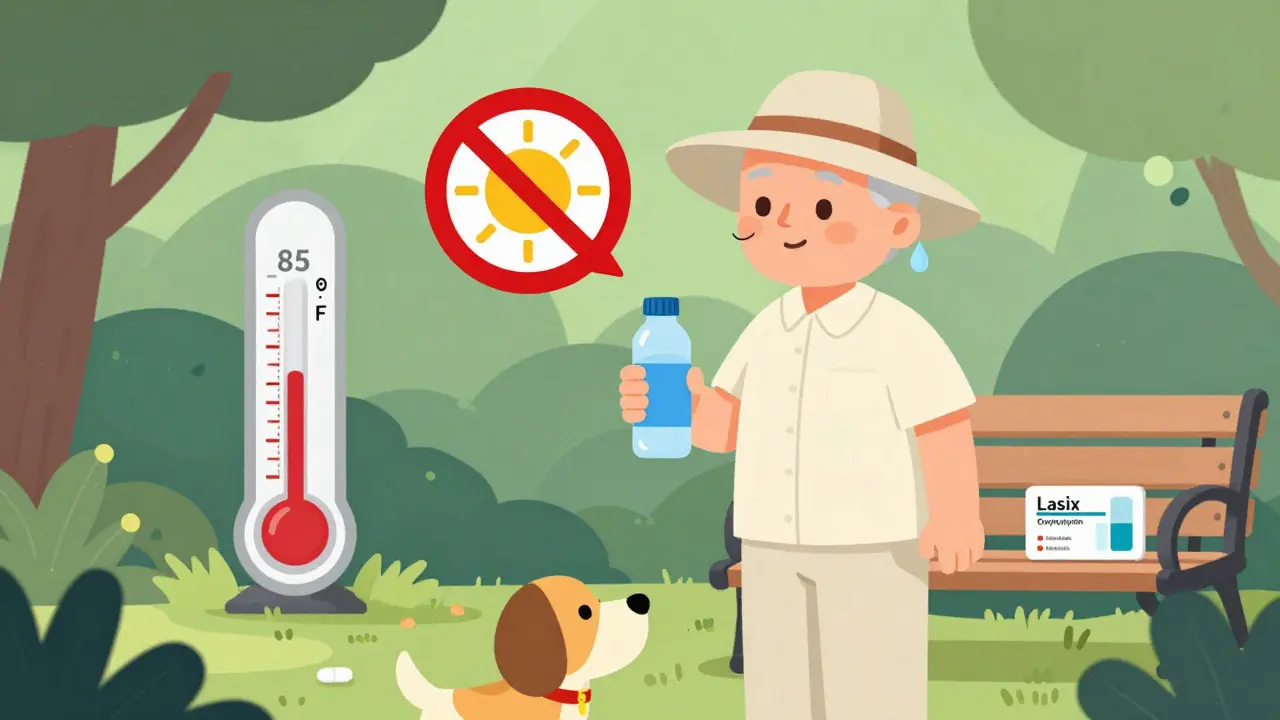
Diuretics-often called water pills-help your body get rid of extra fluid. That’s why they’re used for high blood pressure and heart failure. Common ones include furosemide (Lasix), hydrochlorothiazide (Microzide), and chlorthalidone (Hygroton). But in hot weather, they work against you. These drugs make you pee more. That sounds helpful, but when it’s hot, your body needs every drop of fluid to sweat and cool down. Diuretics drain that away. You lose sodium, potassium, and water faster than your body can replace it. That leads to dehydration, low blood pressure, dizziness, and even heart rhythm problems. A 2022 study of over 1.2 million Medicare patients found that people on loop diuretics had a 37% higher chance of being hospitalized for heat-related illness during summer months-even when temperatures were just above 80°F (26.7°C). That’s not a heatwave. That’s a warm Tuesday. And the risk doesn’t wait for extreme weather. It shows up when you’re gardening, walking the dog, or sitting in a car with the windows up.Why Anticholinergics Block Your Body’s Cooling System
Anticholinergics are another group of drugs that quietly increase heat risk. They’re used for overactive bladder (oxybutynin, tolterodine), Parkinson’s, depression (amitriptyline), and even allergies. But here’s the problem: they stop your body from sweating. Sweating is your body’s main way of cooling off. Anticholinergics block the chemical signal (acetylcholine) that tells your sweat glands to activate. Studies show that strong anticholinergic drugs-those with an Anticholinergic Burden Score (ACB) of 3-can reduce sweating by 30% to 50%. That means your body can’t cool down, even if you’re outside in 90°F heat. The CDC lists anticholinergics as one of the top medication classes linked to heat-related deaths. During the 2021 Pacific Northwest heat dome, 63% of people who died from heat exposure were taking either a diuretic or an anticholinergic. Many of them didn’t feel sick until it was too late. Why? Because these drugs can also cause confusion, dry mouth, and drowsiness-symptoms that look like heat exhaustion but are actually caused by the medication itself.The Combined Danger: When Medications Multiply Risk
Most people don’t take just one of these drugs. Older adults often take multiple prescriptions. A 75-year-old with high blood pressure might be on hydrochlorothiazide. If they also have an overactive bladder, they might be on oxybutynin. And if they’re dealing with chronic pain or depression, they could be taking amitriptyline. That’s three medications, all working together to shut down your body’s ability to handle heat. This isn’t theoretical. In a 2023 study published in the Journal of Thermal Biology, researchers found that people taking multiple medications with anticholinergic effects showed no ability to regulate core body temperature during heat exposure-even if each drug alone seemed mild. The effects add up. It’s not just the drugs. It’s the combination. And here’s the scary part: you might not feel anything wrong until your body starts shutting down. No sweating. No thirst. Just confusion, weakness, or fainting. That’s why many heat-related deaths happen indoors, in homes without air conditioning, with people who don’t realize they’re in danger.
What You Should Do-Practical Steps That Work
You don’t have to stop your medications. But you do need to adjust how you live during hot weather. Here’s what actually helps:- Drink water-even if you’re told to limit fluids. If you’re on a diuretic for heart failure, your doctor may have told you to restrict water. That’s fine in normal weather. But in heat, your body needs more fluid to sweat and survive. Talk to your doctor about temporarily increasing your fluid intake during hot spells. Don’t guess. Ask.
- Check your sweat. If you’re on an anticholinergic and you don’t sweat-even when it’s hot and you’re moving-you’re at risk. Your body isn’t cooling. That’s a red flag. Stay indoors, use fans, and avoid physical activity during peak heat hours (10 a.m. to 4 p.m.).
- Wear the right clothes. Light-colored, loose, breathable fabrics help. Dark clothes absorb heat. Tight clothes trap it. Cotton and linen are better than polyester. And wear a wide-brimmed hat. Sunscreen matters too-many anticholinergics make your skin more sensitive to sunburn.
- Use a buddy system. If you’re over 65, take anticholinergics, or have memory issues, have someone check on you twice a day during heat events. Call. Text. Drop by. Because if you’re confused from the medication or the heat, you won’t know to ask for help.
- Know the warning signs. Headache, nausea, dizziness, muscle cramps, rapid heartbeat, confusion, or dry skin with no sweat. These aren’t just “feeling off.” These are signs your body is failing. Call 999 or go to A&E immediately.
Don’t Stop Your Meds-But Talk to Your Doctor
Never stop taking diuretics or anticholinergics on your own. Stopping suddenly can cause your blood pressure to spike, your heart to struggle, or your bladder to become uncontrollable. That’s dangerous too. Instead, talk to your doctor before the next heatwave. Ask:- “Do any of my medications make me more sensitive to heat?”
- “Should I adjust my dose during summer?”
- “Is there a safer alternative for my condition?”

The Bigger Picture: Climate Change Is Making This Worse
The UK is getting hotter. The number of days above 90°F (32.2°C) has increased by nearly 50% since the 1970s. Heatwaves are longer, more frequent, and more intense. And as the population ages, more people will be taking these medications. The CDC and the Environmental Protection Agency now recognize medication-heat interactions as a major public health threat. In 2023, the EPA reported that 92% of heat-related deaths in the U.S. involved people taking at least one medication that interferes with body temperature control. That’s not a coincidence. It’s a pattern. Research is underway to better understand this. The National Institute on Aging is funding $4.2 million in new studies. Scientists are tracking medication use alongside weather data to build risk models. But that won’t help you tomorrow.What You Can Do Today
If you or someone you care about takes diuretics or anticholinergics:- Make a heat safety plan with your doctor.
- Keep a water bottle with you at all times.
- Know your medication names and side effects.
- Use a thermometer in your home. If it’s above 80°F, take action.
- Have a contact who checks on you daily during heat alerts.
Can I stop taking my diuretics if it’s hot outside?
No. Stopping diuretics suddenly can cause dangerous fluid buildup, high blood pressure, or heart problems. Instead, talk to your doctor about adjusting your dose or fluid intake during hot weather. Never change your medication without medical advice.
Do all anticholinergics stop you from sweating?
Not all, but the strong ones do. Medications with an Anticholinergic Burden Score (ACB) of 3-like oxybutynin, tolterodine, and amitriptyline-are the most likely to reduce sweating by 30-50%. Weaker ones (ACB ≤ 2) have little to no effect. Check your medication’s ACB score with your pharmacist or doctor.
I don’t feel thirsty. Does that mean I’m not dehydrated?
No. Dehydration doesn’t always cause thirst, especially in older adults or people on anticholinergics. Your body’s thirst signal can be turned off by the medication. If you’re on these drugs, drink water regularly-even if you don’t feel like it. Don’t wait for thirst.
Are there safer alternatives to anticholinergics for overactive bladder?
Yes. For overactive bladder, options like mirabegron (Myrbetriq) or pelvic floor therapy don’t block sweating. Botox injections in the bladder are also an option. Talk to your doctor about switching if you’re at high risk for heat illness. The benefits of avoiding heat-related danger can outweigh the convenience of your current pill.
How do I know if my medication has a high anticholinergic burden?
Ask your pharmacist or use the Anticholinergic Cognitive Burden (ACB) scale. Common high-score (ACB=3) drugs include oxybutynin, tolterodine, amitriptyline, diphenhydramine (Benadryl), and some older antipsychotics. Many online tools list ACB scores by drug name. Write them down and bring them to your next appointment.
Should I avoid going outside during summer if I take these medications?
You don’t have to stay inside, but be smart. Avoid direct sun between 10 a.m. and 4 p.m. Walk in the early morning or evening. Stay in air-conditioned places when possible. Use fans, cool showers, and damp cloths on your neck and wrists. Even small cooling methods can help when your body can’t sweat.
Lily Steele
January 31, 2026 AT 22:09Just had my mom go to the ER last week because she thought she was just tired. Turns out she was dehydrated and her meds were making it worse. This post saved her life. Thanks for sharing.
Rohit Kumar
February 2, 2026 AT 12:05India’s summer is brutal. My uncle takes hydrochlorothiazide and still goes to work in the fields at noon. No one tells him this stuff. We need public service announcements in local languages. This isn’t just a Western problem.
Gaurav Meena
February 3, 2026 AT 14:26As someone who’s seen grandparents struggle with this, I’m so glad someone laid it out like this. My abuela was on amitriptyline and didn’t sweat at all. We thought she was just being stubborn. Turns out her body was shutting down silently. Please share this with your elders. It’s not just about comfort-it’s survival.
Jodi Olson
February 3, 2026 AT 18:37Medication heat interactions are grossly underrecognized in clinical practice. The pharmacokinetic and thermoregulatory interplay between diuretic-induced hypovolemia and anticholinergic-mediated anhidrosis creates a perfect storm for thermolytic failure. We need standardized risk stratification tools in EHRs.
Carolyn Whitehead
February 5, 2026 AT 07:03My neighbor’s 80-year-old dad takes three of these meds. He doesn’t even know he’s at risk. I started leaving water bottles on his porch every morning. Small thing but it feels like something.
Amy Insalaco
February 6, 2026 AT 04:38Let’s be honest-this is just another example of pharmaceutical capitalism prioritizing convenience over physiological integrity. The fact that we’re still prescribing ACB=3 drugs to geriatric populations without mandatory heat-risk counseling is a moral failure of the medical-industrial complex. I’m not even mad-I’m just disappointed.
Katie and Nathan Milburn
February 6, 2026 AT 05:07My wife and I both take diuretics. We’ve started checking the heat index every morning and adjusting our routines. We don’t go out between 11 and 3 anymore. Simple, but effective.
Marc Bains
February 7, 2026 AT 10:21My cousin in Florida got hospitalized last summer. She was on oxybutynin and didn’t realize she wasn’t sweating. She thought she was just overheated. By the time she called 911, her temp was 106. She’s fine now but scared. This needs to be on every prescription label. Like, right there. Not buried in fine print.
kate jones
February 7, 2026 AT 12:30ACB scoring is underutilized in primary care. Pharmacists are best positioned to flag high-risk combinations. We need mandatory ACB review during medication reconciliation for patients >65, especially in regions with >30 days/year above 85°F. Evidence supports this as a Tier 1 preventive intervention.
Natasha Plebani
February 7, 2026 AT 12:36It’s fascinating how the body’s autonomic nervous system gets hijacked by pharmacological agents we assume are benign. Acetylcholine isn’t just about bladder control-it’s the conductor of our thermal symphony. When you mute it, you don’t just silence sweat-you silence the body’s oldest survival mechanism. We’re medicating away evolution.
Kelly Weinhold
February 8, 2026 AT 08:15I’m so glad this is getting attention. My grandma used to say ‘I don’t need water, I’m not thirsty.’ Now I make her sip every hour, even if she’s watching TV. We keep a little jug by her chair. And I text her every day during heat alerts. She says it makes her feel seen. Maybe that’s half the battle.
Kimberly Reker
February 9, 2026 AT 23:59My aunt switched from oxybutynin to mirabegron last year. She says she can finally go outside without feeling like she’s melting. No more dizziness, no more dry mouth. She’s happier. And yes, she still drinks water like it’s her job. Change is possible. It just takes asking the right questions.
Eliana Botelho
February 11, 2026 AT 19:10Wait, so you’re telling me I shouldn’t take Benadryl for allergies in the summer? But I’ve been taking it for years and I’m fine. Also, I don’t think this is real science. I mean, how do you even measure ‘sweating reduction’? Did they just watch people sweat? This feels like fear-mongering wrapped in a white coat.
Rob Webber
February 12, 2026 AT 13:51THIS IS A MASSIVE COVER-UP. Big Pharma knows this kills people. They don’t want you to know because then you’ll stop taking their pills. My uncle died from heatstroke in his sleep. His meds were listed on the death certificate as ‘contributing factors.’ But no one ever told us. This is murder by prescription. Someone needs to go to jail.