
Grapefruit Interactions with Immunosuppressant Medications: Risks and Safety Tips
 Feb, 4 2026
A single glass of grapefruit juice can send your immunosuppressant levels into dangerous territory. These grapefruit interactions are a critical concern for transplant patients. But why does this happen? And what can you do to protect yourself? Let's explore the science and practical steps to stay safe.
How Grapefruit Disrupts Your Medication
This interaction was first discovered in 1989 by researchers at the University of Western Ontario. They were studying how grapefruit juice affected the blood pressure medication felodipine and found patients had two to three times higher drug levels. The culprit? Furanocoumarins in grapefruit-compounds like 6',7'-dihydroxybergamottin (DHB) and bergamottin. These chemicals block the CYP3A4 enzyme in your gut, which normally breaks down medications before they enter your bloodstream. Without this breakdown, your body absorbs much more drug than intended. The effect is irreversible and lasts up to 72 hours. Even if you drink grapefruit juice at different times than your medication, the enzyme remains inhibited.
For immunosuppressants, this is especially dangerous. These drugs are designed to keep your immune system in check after an organ transplant. Too little, and your body might reject the new organ. Too much, and you face serious side effects. But grapefruit can push levels into toxic ranges quickly.
Which Immunosuppressants Are Most Affected?
Not all immunosuppressants react the same way. The biggest risks come from drugs that rely heavily on CYP3A4 for metabolism. Here's what the data shows:
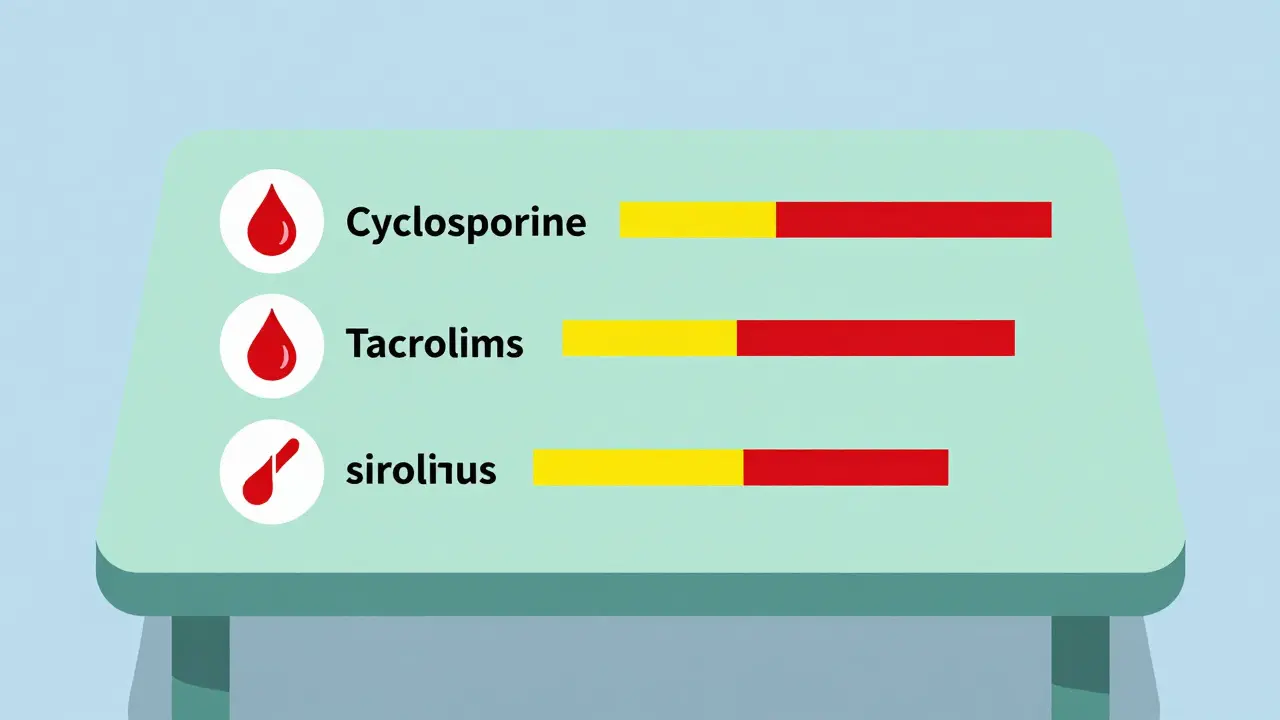
| Medication | Blood Level Increase | Therapeutic Range | Toxic Threshold |
|---|---|---|---|
| Cyclosporine | 50-100% | 100-400 ng/mL | >500 ng/mL |
| Tacrolimus | 30-50% | 5-15 ng/mL | >20 ng/mL |
| Sirolimus | 200-300% | 4-12 ng/mL | >20 ng/mL |
These numbers aren't theoretical. In 2021-2022, Mayo Clinic transplant pharmacists found that 15-20% of unexpected immunosuppressant toxicity cases involved undisclosed grapefruit consumption. One kidney transplant patient on Reddit reported their tacrolimus levels doubled after one glass of grapefruit juice, spiking from 8.2 ng/mL to 24.7 ng/mL within 36 hours-well above the toxic threshold.
The Real-World Consequences
High levels of immunosuppressants can cause serious health issues. The FDA explicitly warns these interactions can lead to "higher risk of infections, kidney problems, and high blood pressure." For transplant patients, this isn't just uncomfortable-it's life-threatening. A 2021 study in the American Journal of Transplantation found that hospitalizations from immunosuppressant toxicity cost an average of $18,500 per incident. Grapefruit interactions account for an estimated 5-7% of these cases.
Dr. David Huang, an FDA pharmacologist, explains: "When grapefruit juice blocks the enzyme, it's easier for the medication to pass from your gut to your bloodstream. Blood levels will rise faster and higher than normal, and in some cases the abnormally high levels can be dangerous." Even small amounts matter. The American Society of Transplantation states that "as little as 200mL (less than one cup) of grapefruit juice is sufficient to cause significant interaction."
What You Need to Do to Stay Safe
The safest approach is complete avoidance. This means no grapefruit juice, no fresh grapefruit, and no products containing grapefruit extract. This includes marmalade made from Seville oranges, which contain the same harmful compounds. The British Liver Trust advises patients to "look at the leaflet in the medicine box or ask your pharmacist" for specific guidance. Remember: the effects last up to 72 hours, so you must avoid grapefruit for three full days before and during your medication regimen.
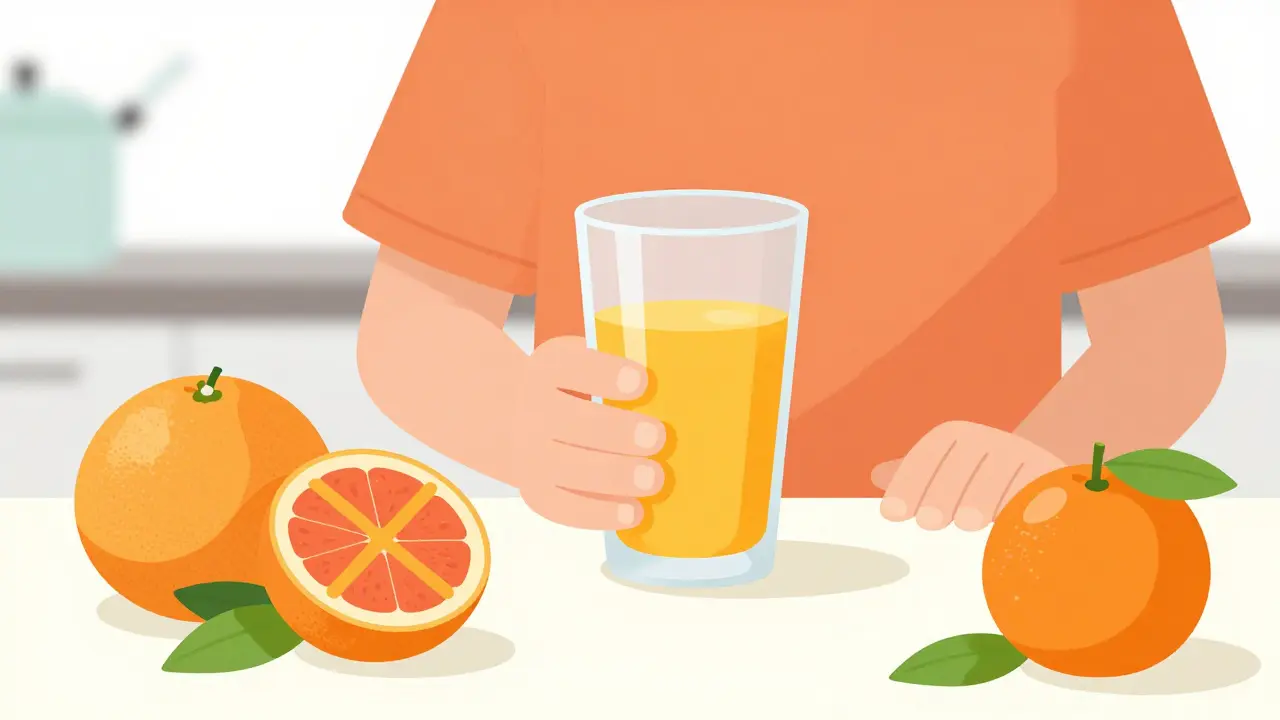
Regular oranges, lemons, and limes are generally safe alternatives. They don't contain the furanocoumarins that cause these interactions. But always check with your doctor before trying new foods or drinks. If you accidentally consume grapefruit, contact your healthcare team immediately. They may need to check your blood levels and adjust your dose. Transplant centers like Memorial Sloan Kettering explicitly warn: "no grapefruit, pomelo, or Seville oranges in any form-juice, fresh fruit, or extracts."
Frequently Asked Questions
Can I drink orange juice instead of grapefruit juice?
Yes, regular oranges and lemons are safe. They don't contain the furanocoumarins that block CYP3A4. However, avoid Seville oranges (used in marmalade) as they have the same harmful compounds as grapefruit.
How long does grapefruit's effect last?
Up to 72 hours. This is because the furanocoumarins bind irreversibly to the CYP3A4 enzyme. Even if you stop drinking grapefruit juice, the enzyme remains blocked for three days. That's why you must avoid grapefruit for three full days before and during your medication regimen.
What should I do if I accidentally eat grapefruit?
Contact your transplant team immediately. They'll likely check your blood levels and may adjust your medication dose. For example, the University of Pittsburgh Medical Center's protocol says to check levels within 24 hours and reduce the dose by 25-50% pending results. Don't wait for symptoms to appear-early intervention is critical.
Are all immunosuppressants affected by grapefruit?
No. Only those metabolized by the CYP3A4 enzyme. Common ones include cyclosporine, tacrolimus, sirolimus, and everolimus. Always check your medication label or ask your pharmacist. New research in March 2023 added everolimus (Zortress) to the list of high-risk immunosuppressants.
Is there a safe amount of grapefruit I can consume?
No. Even small amounts-like one glass of juice-can cause dangerous interactions. Studies show that 200mL (less than one cup) is enough to significantly increase drug levels. The safest choice is complete avoidance for the duration of your immunosuppressant treatment.
lance black
February 6, 2026 AT 01:53Avoid grapefruit entirely. No exceptions.
Joyce cuypers
February 7, 2026 AT 15:59Hey everyone I just wanted to share my experience with grapefruit and immunosuppressants.
My cousin had a kidney transplant and was on tacrolimus.
They told her to avoid grapefruit completely.
She didn't know about it at first and had a glass of juice.
Her levels spiked and she almost had rejection.
It's scary.
I've since become super careful.
I check all food labels.
Even marmalade has grapefruit in it sumtimes.
The British Liver Trust says to avoid anything with Seville oranges.
They're the same as grapefruit.
I always ask my pharmacist before trying new foods.
It's so important to stay safe.
I've learned that even small amounts can be dangerous.
The effect lasts up to 72 hours.
So you have to avoid it for three days before and during meds.
I've read that 200ml is enough to cause issues.
That's less than a cup.
So no grapefruit juice no fresh fruit no extracts.
I've also heard about other fruits like pomelo.
They're bad too.
Always check with your doctor.
It's better to be safe than sorry.
I've had to give up my favorite breakfast juice but it's worth it.
Don't take chances with your transplant.
Stay vigilant.
Check everything.
Trust me I've been there.
It's not worth the risk.
Just say no to grapefruit.
Diana Phe
February 8, 2026 AT 22:37This is all a conspiracy to make people dependent on drugs. Grapefruit is perfectly safe. Trust me I know
Carl Crista
February 8, 2026 AT 23:40The FDA is lying about grapefruit Its a government plot They want you to buy more drugs The science is fake
Lisa Scott
February 10, 2026 AT 12:30The CYP3A4 enzyme inhibition is a myth propagated by Big Pharma Studies show no correlation This is a manufactured crisis
Georgeana Chantie
February 11, 2026 AT 01:28I don't trust this info. It's probably a government scam. 🤔
Cullen Bausman
February 11, 2026 AT 02:16This is a clear case of misinformation Grapefruit is dangerous and should be avoided The science is clear
Cole Streeper
February 12, 2026 AT 05:31You're wrong The government is hiding the truth Grapefruit is safe They want to control us
jan civil
February 13, 2026 AT 09:40Grapefruit blocks CYP3A4 enzyme. Always check with your pharmacist.
Elliot Alejo
February 14, 2026 AT 22:22This is important info. I always make sure to avoid grapefruit products and check with my doctor regularly.
Brendan Ferguson
February 16, 2026 AT 10:32Grapefruit interactions are real but manageable. Always follow your doctor's advice. They know your specific case best.