
Floaters and Flashes: What They Mean and When to See a Doctor
 Dec, 16 2025
Ever looked up at a clear blue sky and seen little dots or squiggles darting around? Or caught sudden streaks of light out of the corner of your eye, like a camera flash, even when you’re not near a bright source? You’re not alone. These are called floaters and flashes, and they’re far more common than most people realize. For many, they’re just a mild annoyance. But for others, they’re a warning sign - one that needs urgent attention.
What Are Floaters and Flashes?
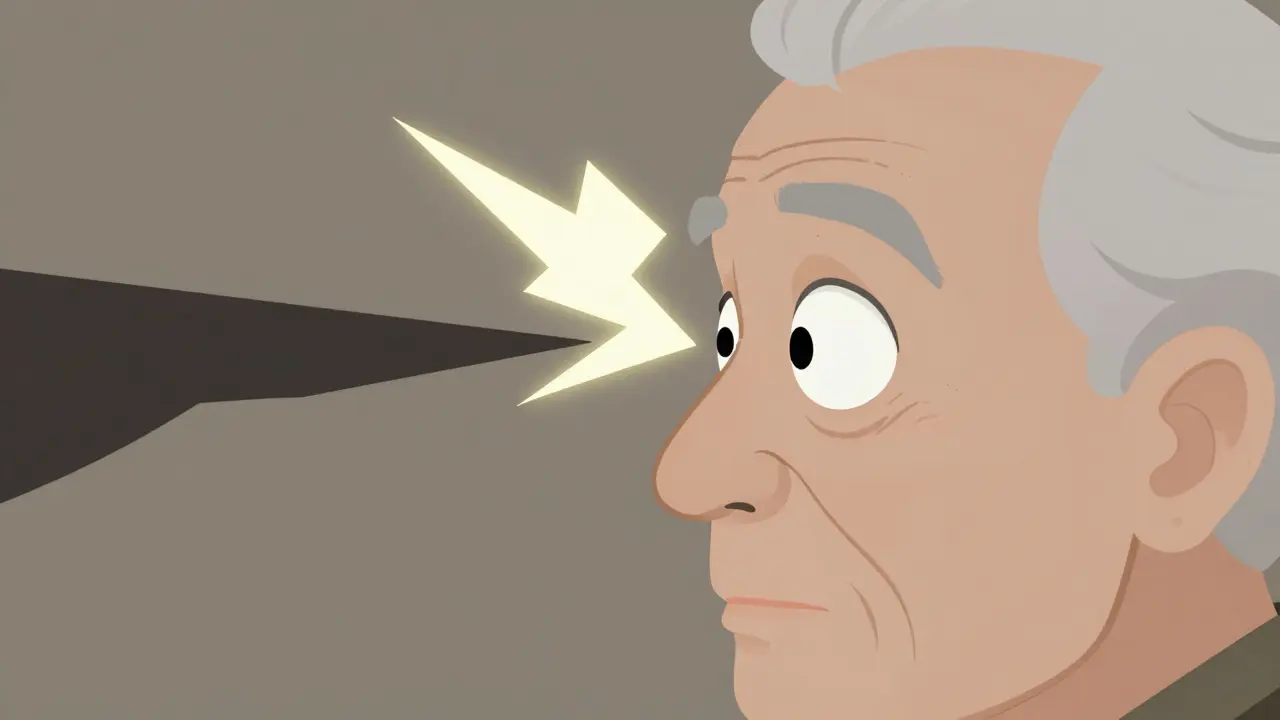
Floaters are tiny shadows that drift across your vision. They look like specks, threads, cobwebs, or small bugs that move when you move your eyes. They’re most noticeable against bright backgrounds - like a white wall, a computer screen, or a clear sky. Flashes, on the other hand, are brief bursts of light, often seen at the edge of your vision. They can feel like a camera bulb going off, or a lightning streak in your peripheral sight. These aren’t problems with your eyesight itself. They’re caused by changes inside your eyeball, specifically in the vitreous humor - the clear, gel-like substance that fills the space between your lens and retina. It’s made mostly of water, but also contains collagen fibers that form a delicate scaffold. As you age, that scaffold breaks down. The gel starts to shrink, liquefy, and pull away from the retina. This is called posterior vitreous detachment, or PVD. PVD is normal. It happens to about 75% of people over 65 and nearly two-thirds of those over 70. But while it’s common, it’s not always harmless. The real danger comes when the pulling vitreous tugs too hard on the retina - and tears it.Why Does This Happen as We Age?
Your vitreous starts changing around age 40, but most people don’t notice anything until their 50s or 60s. The collagen fibers clump together, forming tiny bits of debris. These clumps cast shadows on the retina - that’s what you see as floaters. As the vitreous pulls away from the back of the eye, it can tug on the retina. That tug stimulates the retina’s light-sensitive cells, and your brain interprets it as a flash of light. This process isn’t sudden. It usually happens gradually over weeks or months. But sometimes, it happens fast - especially if you’re nearsighted. People with myopia often develop PVD 10 to 15 years earlier than others because their eyes are longer, creating more tension between the vitreous and retina. You might only notice these symptoms in one eye at a time. That’s because each eye ages differently. One eye might have a big floater while the other is still fine. It’s not unusual to feel like your vision is changing unevenly.When Are Floaters and Flashes Dangerous?
Most of the time, floaters and flashes are harmless. They don’t damage your vision. In fact, many people learn to ignore them. The brain eventually adapts and stops paying attention. Within six months, the floaters often settle out of your central vision, and the flashes fade. But there’s a red flag: sudden changes. If you go from having no floaters to seeing a sudden shower of new ones - especially if they come with flashes - that’s not normal aging. It could mean the vitreous is pulling so hard on the retina that it’s tearing. A retinal tear is serious. Left untreated, fluid can leak behind the retina and cause it to detach. A detached retina is a medical emergency. Without prompt treatment, it can lead to permanent vision loss. Here’s what to watch for:- Sudden increase in floaters - not one or two, but dozens or more
- Flashes that keep happening, especially in clusters
- A dark curtain or shadow moving across your vision
- Sudden loss of side vision
- Blurred or distorted vision that doesn’t go away
Who’s at Higher Risk?
Not everyone who gets floaters and flashes needs to panic. But some people are at higher risk for complications:- People over 65 - the risk of PVD climbs sharply with age
- Nearsighted individuals - their longer eyes create more tension
- People who’ve had eye surgery - like cataract removal
- Those with a history of retinal tears or detachments
- People with diabetes or inflammatory eye conditions - these can cause bleeding inside the vitreous, which looks like floaters
What Happens During an Eye Exam?
If you go to the doctor with these symptoms, they won’t just glance at your eyes. They’ll dilate your pupils with drops. That lets them see the back of your eye clearly - the retina, the vitreous, and any signs of damage. They’ll look for:- Retinal tears - small holes or rips in the retina
- Detached retina - where the retina has pulled away from its normal position
- Vitreous hemorrhage - bleeding inside the eye, which can look like a cloud of dark spots
- Signs of inflammation or infection
What If It’s Just PVD?
If your doctor confirms it’s just posterior vitreous detachment with no tears or detachments, you’re in the clear. No treatment is needed. You don’t need surgery, eye drops, or special vitamins. The floaters will likely become less noticeable over time. Your brain gets used to them. Some people say they disappear entirely after six months. Others still see them, but they’re no longer bothersome. You might be tempted to shake your head or rub your eyes to make them go away. Don’t. That won’t help - and it could even cause more damage if you’re at risk for a tear.What About Laser Treatment for Floaters?
You might have heard about laser surgery to “zap” floaters. It’s called vitreolysis. A YAG laser is used to break up the clumps of collagen. But here’s the catch: it’s not widely recommended. The American Society of Retina Specialists says there’s not enough solid evidence to prove it’s safe and effective for most people. Insurance in the U.S. usually doesn’t cover it. And there’s a risk - the laser could accidentally hit the retina, causing more damage. For the vast majority of people, observation is the best approach. Wait it out. Let your brain adapt. It’s safer and more reliable than unproven treatments.
Can You Prevent Floaters and Flashes?
Unfortunately, no. PVD is part of aging. You can’t stop it. But you can reduce your risk of complications.- Control your blood sugar if you have diabetes - high glucose levels can damage blood vessels in the eye and cause bleeding
- Manage high blood pressure - it affects blood flow to the retina
- Wear protective eyewear during sports or risky activities - trauma can trigger PVD or retinal tears
- Get regular eye exams - especially after age 50
Erik J
December 16, 2025 AT 14:12I’ve had floaters since my late 30s, mostly just one big one that drifts like a tiny jellyfish. Never thought much of it until last year when I got a sudden flash during a walk. Didn’t panic, but I called my optometrist the next day. Turned out to be a tiny retinal tear. Laser fixed it in 10 minutes. Seriously, if you feel something new - don’t wait. It’s not worth the risk.
Still see the floater, but now I know it’s just a ghost. No big deal.
Steven Lavoie
December 17, 2025 AT 08:55The vitreous humor’s structural degradation is a fascinating biophysical process, and your explanation of posterior vitreous detachment as a mechanical consequence of collagen network liquefaction is both accurate and elegantly simplified. I appreciate the emphasis on temporal progression - many patients misinterpret the gradual nature of PVD as an acute event, leading to unnecessary anxiety.
That said, I would caution against overgeneralizing the efficacy of observation. In my clinical experience, patients with high myopia (> -6D) often present with symptomatic PVD as early as age 35, and the risk of retinal break is statistically significant even without acute flashes. Early detection remains paramount.
Brooks Beveridge
December 18, 2025 AT 10:09Hey, just wanted to say - you’re not alone. I was terrified the first time I saw flashes. Felt like my brain was glitching. Took me weeks to even say anything to my doctor. But once I did? Relief. Like finding out the scary noise in the house was just the pipes.
You got this. Your eyes are tough. And if you’re reading this, you’re already doing the right thing - paying attention. That’s half the battle.
And no, rubbing your eyes won’t make the floaters go away. I tried. Spoiler: it didn’t. 😅
Meghan O'Shaughnessy
December 19, 2025 AT 21:01I’m 42 and started getting floaters two years ago. My mom had a detached retina at 58. I’ve been paranoid ever since. But honestly? The article made me feel less crazy. I didn’t realize so many people have them. I just thought I was going blind. Turns out I’m just aging. Weird.
Still, I booked my dilated exam this week. Better safe than sorry. My kids need their mom to see their faces clearly.
Kaylee Esdale
December 20, 2025 AT 05:26Jody Patrick
December 21, 2025 AT 21:18Why are we even talking about this? It’s just a natural part of getting old. If you’re too weak to handle a few floaters, maybe you should stop staring at screens all day. We didn’t have eye doctors in the 70s and we didn’t die from seeing shadows. Grow up.
CAROL MUTISO
December 23, 2025 AT 15:49Oh honey, I love how this article doesn’t just say ‘go to the doctor’ and leave you hanging. It gives you the why, the when, the who - like a gentle hand on your shoulder saying ‘hey, this is normal, but here’s the line you don’t cross.’
And that bit about laser treatment? Perfect. So many influencers push ‘miracle’ cures for floaters. It’s like people think the eye is a smartphone you can just reboot. Nah. Your retina’s not a screen. It’s a living thing. Treat it like one.
Also, I’m 51 and still see one floater. It’s my little ghost friend. I wave at it sometimes. It’s okay to live with weird things. As long as they don’t start screaming.
Martin Spedding
December 24, 2025 AT 15:59Chris Van Horn
December 25, 2025 AT 05:02While the article is superficially accurate, it fails to address the systemic failures in American optometric education. The emphasis on 'observation' as a default strategy is dangerously inadequate. In Germany and Japan, vitreous analysis via OCT is standard protocol for patients over 45 - yet here, we rely on patient self-reporting and dilated exams that are often scheduled months out.
Furthermore, the dismissal of YAG vitreolysis as 'unproven' ignores peer-reviewed studies from the Journal of Ophthalmic Innovation (2022) and the European Retina Society’s meta-analysis. The reluctance to adopt these techniques is less about evidence and more about entrenched institutional inertia - and profit-driven insurance models that favor reactive over preventive care.
For those of you who are 'just waiting' - you are being complicit in your own vision loss. Knowledge is not enough. Action is required. Demand better.
amanda s
December 25, 2025 AT 14:14My cousin lost her vision in one eye because she waited three weeks to get checked. Three. Weeks.
And now she can’t see her grandkids’ faces.
So if you’re thinking ‘maybe it’ll go away’ - NO. IT WON’T.
Call your doctor TODAY. Not tomorrow. Not next week. TODAY.
I’m not being dramatic. I’m being your last warning.
And if you’re reading this and you’re healthy? Be grateful. And tell someone else. Someone who might not listen to a doctor. But might listen to you.