
Corneal Ulcers: Contact Lens Risks and Urgent Care Guide
 Apr, 4 2026
To understand why this happens, we first need to look at keratitis, which is a broader term for inflammation of the cornea. Think of keratitis as the warning phase. When the cornea becomes inflamed, it becomes more susceptible to infection. If bacteria, fungi, or parasites penetrate the corneal surface, they eat away at the tissue, creating a literal hole or ulcer. While a corneal abrasion is just a superficial scratch that usually heals on its own, an ulcer involves actual tissue loss. This is why you can't just "wait and see" if the redness goes away.
The Real Risk of Contact Lenses
If you wear contacts, your risk profile changes dramatically. It isn't the lenses themselves that are the problem, but how they interact with your eye's biology. When you put a lens in, you are placing a barrier between your eye and the air. This blocks oxygen from reaching the corneal tissue, making the eye more vulnerable to opportunistic pathogens.
The numbers are honestly startling. A person who wears contacts is about 10 times more likely to develop a corneal ulcer than someone who doesn't. But the risk skyrockets when you ignore the "take them out" rule. Someone who sleeps in their lenses is roughly 100 times more likely to suffer from an ulcer. This is especially true for soft contact lenses, which act like a sponge, trapping bacteria and debris against the surface of the eye for hours on end.
It's not just about the time the lenses are in, but how they get there. Bacteria from your fingertips or non-sterile cleaning solutions get trapped under the lens, creating a warm, moist environment where pathogens thrive. Combine this with a tiny scratch from a torn lens, and you've essentially opened a door for infection to enter the deeper layers of the cornea.
| Feature | Corneal Abrasion | Corneal Ulcer |
|---|---|---|
| Nature of Injury | Superficial scratch | Open sore / Tissue loss |
| Primary Cause | Foreign object / Dryness | Infection (Bacterial/Fungal) |
| Healing Process | Usually heals quickly on its own | Requires aggressive medication |
| Risk of Blindness | Low (if treated) | High (if neglected) |
Red Flags: When to Panic (and When to Act)
Spotting a corneal ulcer early is your best bet for saving your sight. Because early symptoms can mimic a common cold or mild allergies, many people ignore the signs until it's too late. You need to look for a specific cluster of "red flags."
The most telling sign is a white or greyish spot on the cornea. If you look in the mirror and see a tiny white patch on the colored part of your eye, that is an emergency. Other symptoms include:
- Severe eye pain that doesn't go away with blinking.
- Photophobia, which is an extreme sensitivity to light (you'll want to squint or close your eyes in a bright room).
- Blurred or hazy vision that doesn't clear up with drops.
- Excessive watering and discharge (pus).
- A bloodshot appearance that is localized around the iris.
If you experience these, the first thing you must do is stop wearing your contact lenses immediately. Do not "try them out one more time" to see if the pain is gone. Get to an eye specialist immediately.

What Happens at the Doctor's Office?
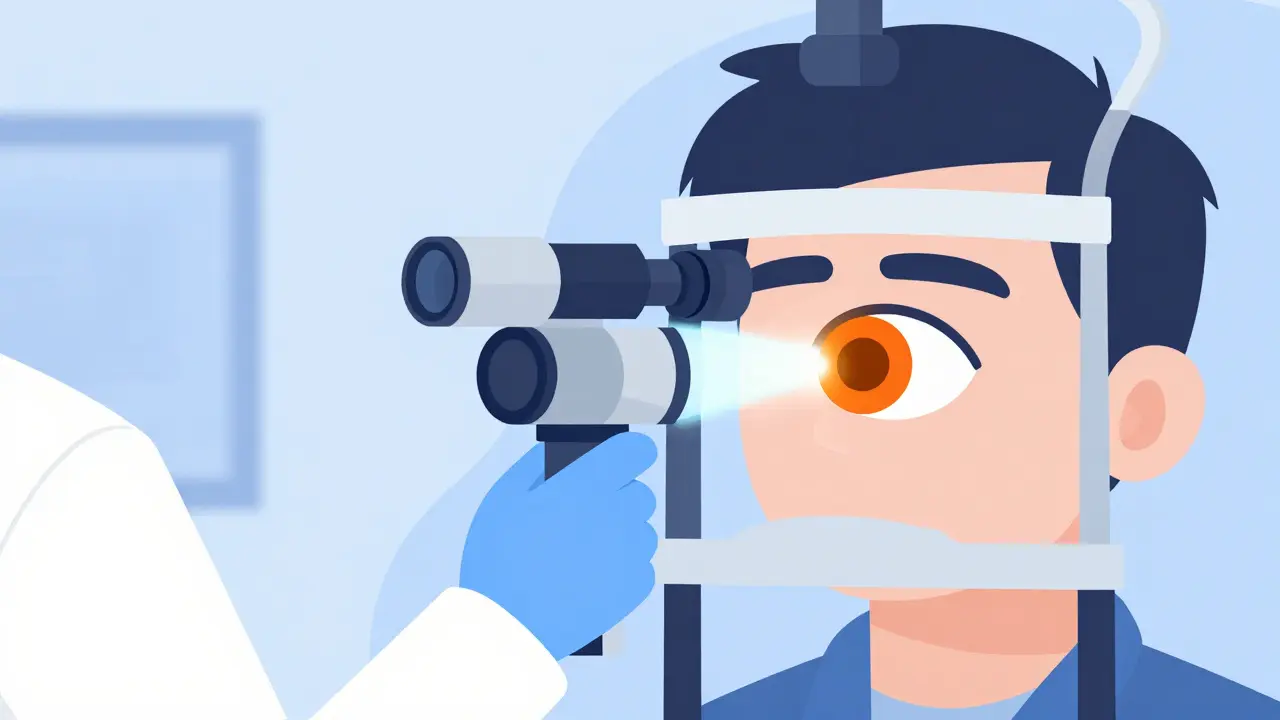
When you arrive at urgent care, the doctor won't just look at your eye with a flashlight. They use a series of specific tools to map the damage. First, they use fluorescein staining. This is a bright orange dye that clings to damaged areas of the cornea, making the ulcer glow under a blue light.
They will also use a slit-lamp examination, which is a high-powered microscope that allows them to see the exact depth of the tissue loss. In serious cases, they may perform a corneal scraping. This involves taking a tiny sample of the ulcer to send to a lab to figure out exactly which bug is causing the infection-whether it's a common bacterium, a fungus, or the rare Acanthamoeba parasite often linked to contaminated water.
The Road to Recovery: Treatment Options
Treatment isn't one-size-fits-all. It depends entirely on the cause and the location of the ulcer. If the ulcer is small and not threatening your central vision, doctors usually start with empirical treatment using fluoroquinolones, which are powerful broad-spectrum antibiotic drops.
However, a "sight-threatening" ulcer is treated much more aggressively. This usually applies if the ulcer is larger than 2mm or located right in the center of your visual axis. In these cases, the doctor will prioritize a culture analysis to ensure the medication matches the pathogen perfectly. For example, viral ulcers require antivirals like acyclovir, while fungal infections need specialized antifungal agents that are often much harder to administer.
In the worst-case scenario, if the infection causes massive scarring or a perforation of the cornea, you might need a corneal transplant. This is a major surgical procedure to replace the damaged dome with healthy tissue from a donor. This is why starting treatment within 48 hours is so critical; it prevents the inflammation from reaching a point where a transplant becomes the only option.
How to Keep Your Eyes Safe
Preventing an ulcer is significantly easier than treating one. The most impactful thing you can do is follow your wear schedule. If your lenses are for 14 days, don't push them to 20. If they aren't approved for overnight wear, don't sleep in them-even for one "lazy" night.
Then there is the water problem. You should never expose your eyes to tap water, swimming pools, or hot tubs while wearing soft lenses. Water contains microorganisms that can get trapped behind the lens and cause devastating infections. Always take your lenses out before showering or swimming.
Finally, maintain a strict hygiene routine. Wash your hands with soap before touching your lenses and only use sterile, recommended solutions. Avoid the temptation to "top off" your solution by adding new liquid to old liquid in the case, as this dilutes the disinfectant and encourages bacterial growth.
Can a corneal ulcer go away on its own?
No. Unlike a corneal abrasion, which is a surface scratch, a corneal ulcer is an infection and an open sore. Without medical treatment, the infection will continue to destroy corneal tissue, leading to permanent scarring or vision loss.
How long does it take for a corneal ulcer to heal?
Healing time varies. Bacterial ulcers often respond quickly to antibiotics and can show improvement within a few days, though treatment continues for weeks. Fungal and viral ulcers generally take much longer to resolve and require more specialized medication.
Are steroid eye drops safe for corneal ulcers?
Only if prescribed by a doctor. While steroids can reduce swelling and inflammation, using them improperly during an active infection can actually make the ulcer worse by suppressing the eye's immune response, allowing the infection to spread faster.
Can I wear my contacts if only one eye has an ulcer?
No. You should stop wearing contacts in both eyes immediately. The bacteria or fungus causing the ulcer in one eye may already be present in the other, or it could be residing in your lens case or on the lenses themselves.
What is the difference between an ulcer and keratitis?
Keratitis is a general term for inflammation of the cornea. A corneal ulcer is a specific, more severe form of keratitis where the inflammation has progressed to an open sore with actual loss of corneal tissue.
Sam Hayes
April 4, 2026 AT 05:09just a heads up that switching to daily disposables is a game changer for people who struggle with the cleaning routine because you just toss them and start fresh every morning
Joseph Rutakangwa
April 6, 2026 AT 02:42dailies are definitely safer
Joey Petelle
April 7, 2026 AT 04:15oh look at us pretending that a little bit of tap water is the apocalypse while the rest of the world probably uses river water to wash their eyes and manages not to go blind in a week
it is just typical American hand-wringing over a hypothetical scenario that only affects the fragile elites who can't handle a little microbe in their ocular orbit
Will Baker
April 7, 2026 AT 18:58sure let's all just listen to the "experts" and panic over a white spot when it could probably just be a piece of dust or some weird lighting in your bathroom mirror anyway
Rob Newton
April 9, 2026 AT 07:40Ignorance is bliss.
Aysha Hind
April 9, 2026 AT 12:17The way they push these "sterile" solutions is just a massive cash grab by big pharma to keep us dependent on their chemical cocktails
I bet the actual risks are being manipulated to keep us in a state of perpetual anxiety so we keep buying the expensive brands instead of just using common sense and natural saline that doesn't contain some synthetic sludge designed to erode your natural defenses from the inside out while they laugh all the way to the bank with our vision as the collateral damage in their corporate game of monopoly
Vicki Marinker
April 11, 2026 AT 00:37It is quite tiresome to read such alarmist drivel when the statistical probability for the average user remains marginal at best.
Mark Zhang
April 11, 2026 AT 08:04I totally get how scary this sounds, but just remember that catching it early makes a huge difference
If anyone is feeling anxious, just take the lenses out and make an appointment right away to get some peace of mind. You've got this!
Dee McDonald
April 13, 2026 AT 00:17WE NEED TO SHARE THIS MORE! People really don't realize how dangerous sleeping in contacts is until it's way too late
I've seen people literally lose their sight because they thought one night wouldn't hurt
Everyone needs to set a strict alarm for lens removal and stick to it no matter how tired they are!
Lawrence Rimmer
April 13, 2026 AT 16:52The binary distinction between a scratch and an ulcer is a convenient simplification for the masses but fails to capture the nuance of corneal degradation as a philosophical descent into darkness
Why do we obsess over the biological hole in the eye while ignoring the intellectual holes in our understanding of sensory perception
Hope Azzaratta-Rubyhawk
April 14, 2026 AT 15:36IT IS ABSOLUTELY IMPERATIVE THAT EVERY SINGLE PERSON READING THIS FOLLOWS THE HYGIENE PROTOCOLS TO THE LETTER!
There is no room for error when your eyesight is on the line and the fact that people even consider "topping off" solution is an affront to basic medical common sense
You must be aggressive about your eye health or you will regret it for the rest of your life
Get the right drops, use the right cases, and for heaven's sake, stop showering in your lenses immediately
The medical community provides the guidelines for a reason and ignoring them is nothing short of negligence
We can all maintain perfect vision if we simply have the discipline to follow the rules
Clean your hands, replace your cases, and stop being lazy with your health
Your eyes are the windows to your world and you are letting them get dirty through pure sloth
Stop making excuses for a "lazy night" because blindness is a permanent state of being
The consequences are too high to gamble with for the sake of five minutes of convenience
Follow the schedule or face the scarring
It is a simple choice between discipline and disability
I firmly believe that if everyone just stepped up their game, these emergencies would plummet
Read the instructions, follow the doctor, and stay vigilant
Your future self will thank you for the discipline you show today!