
Combination Drug Substitution: Navigating Legal and Practical Hurdles
 Apr, 23 2026
Imagine a patient walking into a pharmacy with a prescription for two separate blood pressure medications. The pharmacist knows there is a single pill-a combination drug-that contains both ingredients. It's cheaper, easier for the patient to take, and likely to improve how well they stick to their treatment. But here is the catch: in many places, switching that patient to the combination pill without a doctor's explicit sign-off isn't just a clinical choice-it's a legal gamble. This tension between patient convenience and rigid legal frameworks is the core struggle of combination drug substitution today.
For the average person, the difference between a generic and a brand-name drug seems simple. But when we move into the world of combination products, the lines blur. These aren't just "different versions" of the same thing; they are complex chemical cocktails that challenge how we define "equivalent" medicine.
What Exactly Are We Talking About?
Before we get into the legal weeds, we need to be clear on the terminology. A Combination Drug is a chemical composition where at least two active drugs are combined into a single dosage form , such as a tablet or an injectable. You might know these as Fixed-Dose Combinations (FDCs). They were originally a game-changer for treating HIV/AIDS, where taking a handful of pills daily was a massive burden. By putting multiple ingredients into one "polypill," doctors could drastically improve patient compliance.
The FDA defines these broader combination products as anything comprising two or more regulated components, which could be a mix of drugs, biologics, or even medical devices. While the goal is simplicity, the regulatory reality is a mess of overlapping rules.
Generic vs. Therapeutic Substitution: The Great Divide
This is where most of the confusion starts. Most people use the word "substitution" as a catch-all, but in a pharmacy, there are two very different actions happening:
- Generic Substitution: This is the standard process of replacing a brand-name drug with a different formulation of the exact same drug. It's generally legal and encouraged because the active ingredient is identical.
- Therapeutic Substitution: This is the act of replacing a drug with a completely different molecule that is assumed to have a similar effect. For example, switching one type of beta-blocker for another.
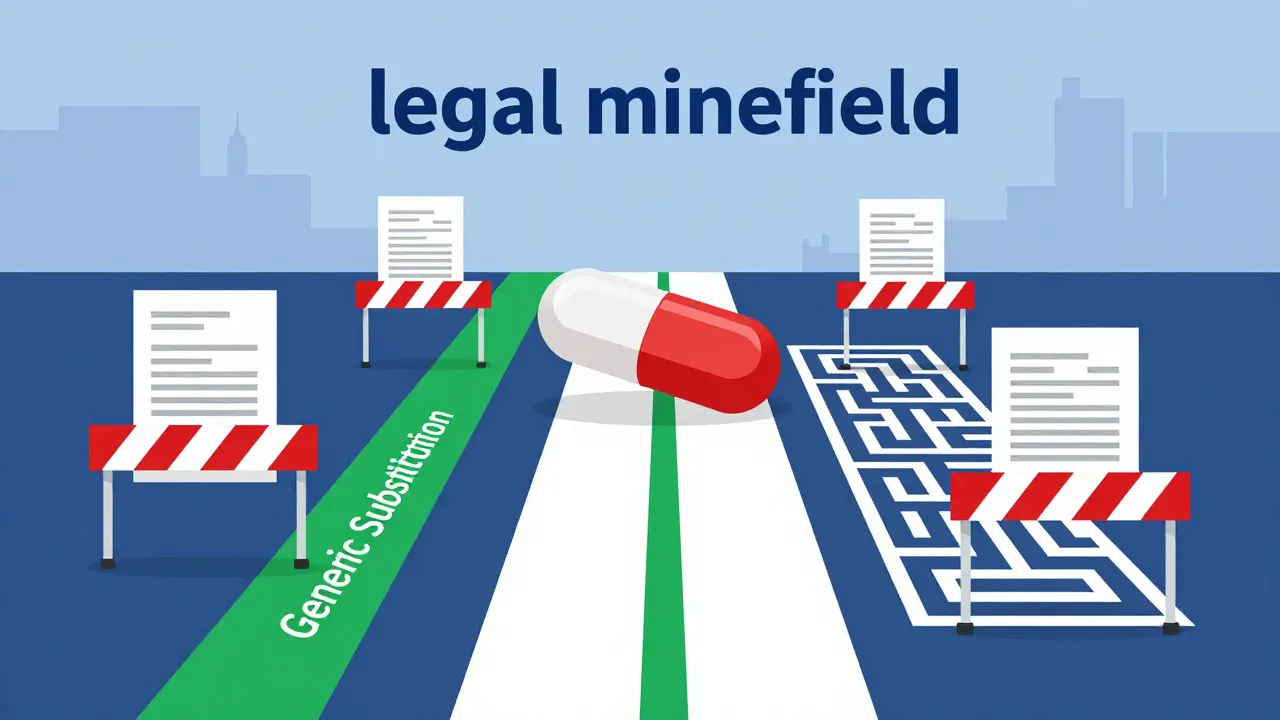
When it comes to combination products, the distinction becomes a legal minefield. If a pharmacist switches a patient from two separate pills to one combination pill, are they performing a generic substitution or a therapeutic one? Because the combination pill contains "extra" stuff (even if it's the same drug), many legal jurisdictions view this as initiating a new therapy, which usually requires a doctor's prescription.
| Feature | Generic Substitution | Therapeutic Substitution |
|---|---|---|
| Active Ingredient | Identical | Different but similar effect |
| Legal Standing | Widely accepted/automated | Often requires prescriber approval |
| Primary Goal | Cost reduction | Clinical optimization/Cost |
| Risk Level | Low (standardized) | Moderate (requires clinical judgment) |
The Legal Deadlocks and "Prescribing by Adaptation"
The legal framework for substitution is often a patchwork of state or regional laws. In the U.S., for instance, many state laws were written for single-entity drugs. They don't account for the nuance of combination products. This leads to a phenomenon called "prescribing by adaptation."
The Alberta College of Pharmacy has pointed out a critical boundary: while a pharmacist might be able to swap one proton pump inhibitor for another, they cannot legally substitute a single drug with a combination product if only one drug was originally prescribed. Doing so is considered "initiating drug therapy," which is the sole domain of the prescriber.
Court cases have reinforced this. In Smith v. CVS Caremark (2022), the 9th Circuit Court ruled that pharmacists cannot substitute a combination product containing additional active ingredients without explicit authorization. This means that even if a pharmacist knows a combination pill is better and cheaper, the law essentially ties their hands to protect the doctor's authority over the patient's regimen.
Practical Challenges on the Pharmacy Floor
If you've ever waited a long time for a prescription to be "verified," you might be seeing this struggle in real-time. Pharmacists are facing an impossible balancing act. On one hand, they want to help patients save money and simplify their lives. On the other, they are terrified of lawsuits or losing their licenses.
According to a survey by the National Community Pharmacists Association, about 68% of independent pharmacists hit a substitution dilemma at least once a month. The confusion usually stems from three areas:
- Modified-Release Mechanisms: If the combination pill releases the drug slower than the individual components, is it still "equivalent"?
- Narrow Therapeutic Index (NTI) Drugs: Some drugs have a very thin window between a helpful dose and a toxic dose. Substituting these without a doctor's precision is incredibly dangerous.
- Cross-Border Rules: In a world where patients might move between states or countries, a substitution that is legal in Denmark (where the Danish Medicines Agency allows replacing a medicine with the same combination of substances) might be illegal in Texas.
The Economic Tug-of-War
Why is there so much pressure to get this right? Money. Generic drugs make up 90% of prescriptions in the U.S., yet they only represent 23% of total spending. There is a massive financial incentive to push patients toward cheaper, combined alternatives. Dr. Jane Chen from the Institute for Clinical and Economic Review suggests that expanding substitution for combination products could slash medication spending for chronic conditions by 15% to 25%.
We can see this working in other systems. The National Health Service (NHS) in the UK has used strict therapeutic substitution protocols for cardiovascular drugs, saving roughly £280 million annually since 2019. However, the risk is real. The American Heart Association warns that improper substitution in heart patients-especially the elderly-could lead to adverse events in up to 8% of cases. One wrong swap could lead to a hospital visit.

Where Do We Go From Here?
The industry is moving toward a more tiered approach. The National Association of Boards of Pharmacy has proposed legislation that separates "simple" combinations (two well-known generic drugs) from "complex" combinations (new mechanisms or high-risk drugs). This would allow pharmacists more freedom with the low-risk stuff while keeping the high-risk decisions with the doctors.
The European Medicines Agency (EMA) continues to warn against substitution without oversight, particularly for complex products. Yet, as the Therapeutic Substitution Consensus Group predicts, by 2025, about 35% of new drug approvals will be combination products. We are heading toward a future where the "single-pill" is the norm, not the exception.
Can my pharmacist switch my two separate pills to one combination pill?
It depends on your local laws and the type of medication. In many regions, the pharmacist cannot do this without a new prescription or explicit authorization from your doctor, as adding or changing the delivery method of a drug is often legally viewed as "initiating therapy."
What is the difference between a generic and a combination drug?
A generic drug is a version of a single active ingredient that is chemically identical to the brand-name version. A combination drug contains two or more different active ingredients combined into one pill or dose to simplify treatment.
Why are combination drugs generally better for patients?
They reduce "pill burden," meaning patients have to take fewer tablets per day. This typically leads to better compliance (patients are less likely to forget a dose) and can often lower the overall cost of the medication.
Is therapeutic substitution dangerous?
It can be, especially for narrow therapeutic index (NTI) drugs where a small change in dose or formulation can lead to toxicity or treatment failure. This is why many health agencies, like the EMA, insist on physician oversight for these switches.
What is a "polypill"?
A polypill is a specific type of combination drug that typically contains four or more active ingredients. They are often used to treat complex chronic conditions like cardiovascular disease by combining several necessary medications into one daily dose.
Next Steps and Troubleshooting
If you are a patient wanting to simplify your medication, the best route is to ask your doctor for a "fixed-dose combination" during your next visit. Don't rely on the pharmacy to make the switch, as they may be legally barred from doing so.
For pharmacists facing these dilemmas, the safest play is to document every attempt to contact the prescriber and adhere strictly to the most conservative interpretation of your state's board of pharmacy guidelines. When in doubt, refuse the substitution until a written authorization is received; the legal risk of an unauthorized switch far outweighs the convenience of the pill.
Carol Yang
April 23, 2026 AT 19:37this is actually such a helpful breakdown of a confusing topic!
Daniel Runion
April 25, 2026 AT 05:03Typical!!! People just love to oversimplify the chemistry of pharmacokinetics... it's absolutely laughable that anyone thinks a "simple" combination is just a matter of convenience!!! The bioequivalence of these cocktails is a complete nightmare to track, and frankly, the legal hurdles are the only thing stopping total chaos in the pharmacy aisles!!!
Anand Mehra
April 26, 2026 AT 20:34law is just a fence for the unimaginative
efficiency is the only true metric here
Michael Deane
April 27, 2026 AT 07:05I dont care what some fancy agency in Denmark thinks about their meds because we do things the right way here in the US and we keep our doctors in charge where they belong and frankly it is about time we stopped listening to these international guidelines that just want to push us into some socialist healthcare nightmare where a pharmacist just decides what you take based on some chart from Europe while ignoring the actual needs of the American patient who deserves the best personalized care without some government bureaucrat in Brussels telling us how to run our pharmacies
Kristen O'Neal
April 28, 2026 AT 04:00It really seems like a failure of communication between the clinic and the pharmacy. If the legal framework is this rigid, maybe we should be pushing for a streamlined digital authorization system where a doctor can approve a switch with one click instead of a whole new prescription process. That would bridge the gap between patient convenience and legal safety.
Sharyl Foster
April 29, 2026 AT 20:51Oh please, the "pill burden" argument is so overblown. Taking two pills instead of one isn't some Herculean task that requires a legal revolution. Most people just like the idea of a shortcut, but the actual clinical risk of not being able to titrate individual doses is way more important than saving five seconds in the morning.
Jaclyn Vo
May 1, 2026 AT 18:14Exactly!!! 🙄 It's literally a disaster waiting to happen if we let pharmacists just play mix-and-match with our hearts and blood pressure!!! Like, imagine the lawsuits!!!! 😱
Vijay AGarwal
May 2, 2026 AT 02:41The tragedy here is the immense waste of human potential and financial resources! We are talking about millions of dollars just evaporating because of outdated statutes! It is a systemic catastrophe that keeps patients in a cycle of inefficiency! We must scream for a legislative overhaul that recognizes the evolving nature of pharmacology or we are simply doomed to stay in the dark ages of medicine!
Andre Ojakäär
May 3, 2026 AT 18:32the nti part is where this actually matters because if you mess with a narrow therapeutic index drug you are basically playing russian roulette with a pharmacy bottle and anyone who thinks that is a simple substitution is delusional lol
James Harrison
May 5, 2026 AT 00:26It's interesting to think about the power dynamic here. The law isn't just protecting the patient, it's protecting the doctor's role as the sole decision-maker. There's a philosophical tension between the expertise of the pharmacist and the authority of the physician.
Eric Mwiti
May 5, 2026 AT 04:53Sure, because nothing says "patient safety" like a rigid legal system that forces people to take more pills than necessary just so a doctor can feel important.
Nikita Shabanov
May 6, 2026 AT 14:22From a clinical perspective, the risk of modified-release mechanisms is often underestimated. If a combination pill uses a different release profile than the individual generics, the steady-state concentration in the blood can change significantly. This is why the caution mentioned in the post is not just legal bureaucracy, but a genuine safety concern for high-risk patients.
Elle Torres Sanz
May 6, 2026 AT 15:54I appreciate the nuance here. It would be wonderful if we could find a middle ground that respects the professional judgment of pharmacists while maintaining a safety net for the patients. Maybe we can look at the UK's NHS model and adapt the parts that work for our own cultural and legal context.
Beena Garud
May 7, 2026 AT 20:41One must contemplate the ethical implications of prioritizing economic efficiency over the rigorous oversight of a licensed physician. While the reduction of the "pill burden" is a noble pursuit, the sanctity of the prescriber-patient relationship remains paramount to ensure the highest standard of care and avoid the pitfalls of systemic error.
Jon Moss
May 8, 2026 AT 23:44I just feel for the pharmacists. Being stuck between wanting to help someone save money and fearing for your license is a stressful place to be. It's a tough spot.