
Addressing Patient Concerns About Biosimilars: Reducing Hesitation
 Mar, 12 2026
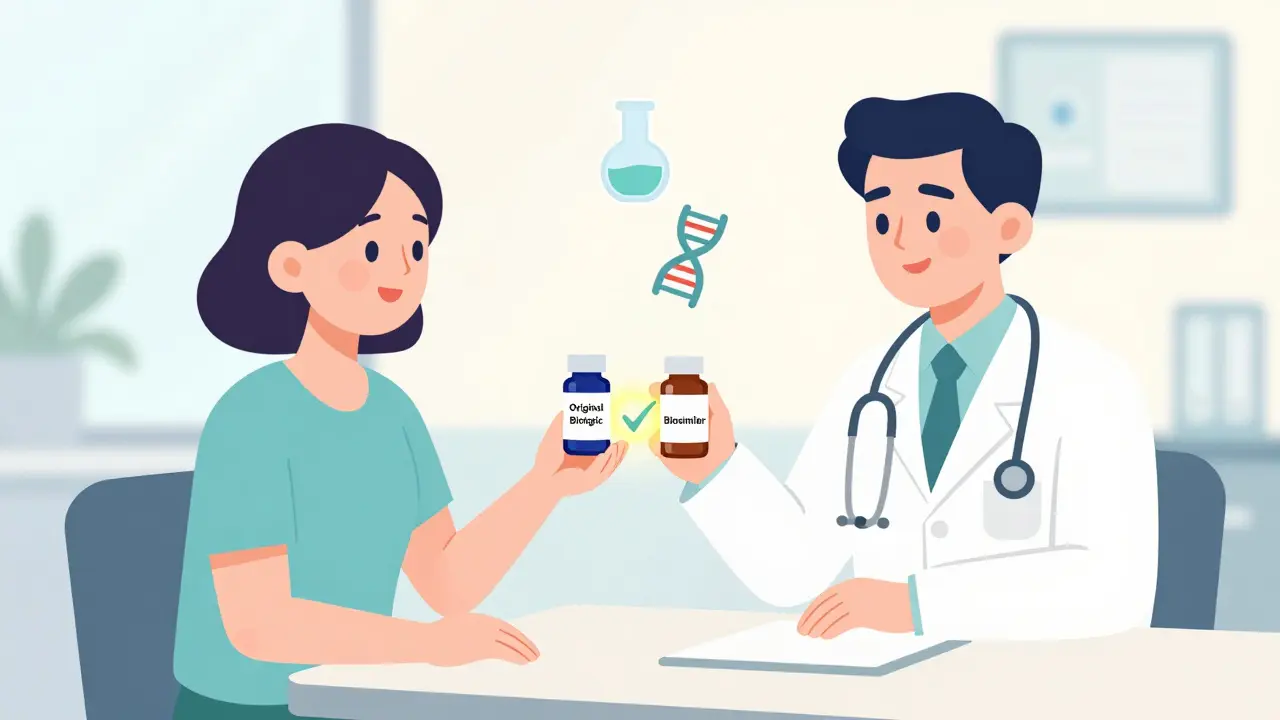
When your doctor suggests switching from your current biologic medication to a biosimilar, it’s natural to feel uneasy. You’ve been on this treatment for months-or maybe years-and it’s kept your condition stable. Now, suddenly, there’s a new name on the prescription. Is it the same? Is it safe? Will it work just as well? These aren’t just questions-they’re real fears that stop many patients from making the switch, even when it could save them hundreds-or even thousands-of dollars a year.
What Exactly Is a Biosimilar?
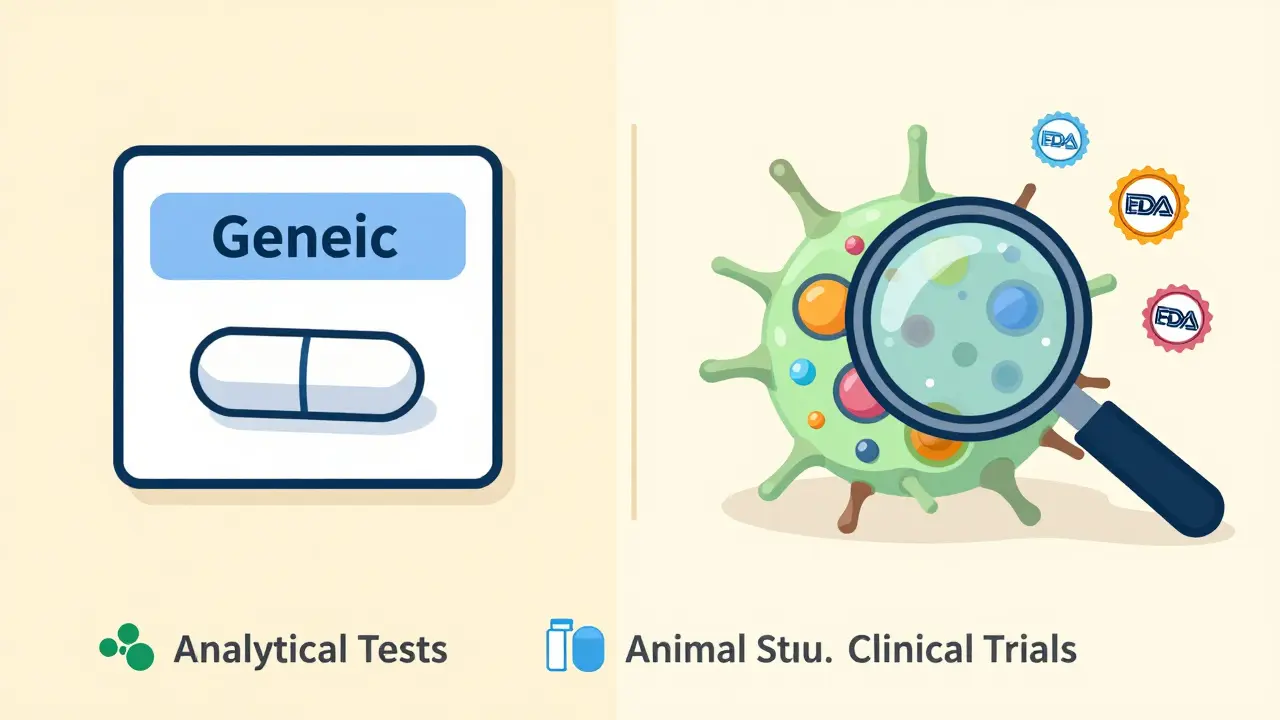
A biosimilar isn’t a generic drug. That’s the first thing to understand. Generics are exact chemical copies of older, simpler pills. Think of them like photocopies: same ink, same paper, same shape. Biosimilars are more like high-resolution replicas of a complex sculpture. They’re made from living cells-often from human or animal tissue-and their structure is incredibly intricate. Even tiny changes in how they’re made can affect how they behave in the body.
The FDA requires biosimilars to go through more than 100 tests before approval. These include analyzing their molecular shape, how they bind to targets, how they’re absorbed, and even how the immune system reacts to them. Then, there are animal studies and clinical trials-usually with hundreds of patients-to confirm they work just like the original. The goal isn’t to be identical. It’s to prove there are no clinically meaningful differences in safety, effectiveness, or side effects.
Since the first biosimilar, Zarxio, was approved in 2015, the FDA has cleared 74 of them as of April 2025. These cover treatments for cancer, rheumatoid arthritis, Crohn’s disease, diabetes, and more. And they’re not just theoretical-they’re being used right now by millions of patients.
Why Do Patients Hesitate?
Most hesitation comes from three places: confusion, fear of the unknown, and bad experiences.
First, confusion. A 2025 survey found that only 31% of patients with chronic illnesses even knew what biosimilars were. Meanwhile, 64% of doctors did. That gap matters. If your doctor says, “We’re switching you to a biosimilar,” without explaining what it means, it sounds like a gamble. Is this a cheaper version? A knockoff? A trial drug?
Second, fear. A study in the Journal of Managed Care & Specialty Pharmacy found that 79% of patients worried biosimilars wouldn’t work as well. Sixty-three percent feared new or worse side effects. These aren’t irrational fears-they’re based on real stories. Reddit threads like r/Pharmacy are full of posts from people who were switched without warning, had a flare-up, and now refuse to try anything new. One patient wrote: “My doctor switched me to a biosimilar for Humira without telling me, and I had a flare-up. Now I’m terrified to switch again.”
Third, bad experiences. In April 2024, CVS removed Humira from most of its commercial formularies, forcing patients onto biosimilars. Within months, the average cost of biologic drugs dropped by 2.3 percentage points. But patient satisfaction scores fell by 15%. Why? Because many felt blindsided. They weren’t consulted. They weren’t educated. They were just told: “This is what you’re getting now.”
Cost Savings? Why Don’t I See Them?
Here’s the frustrating part: biosimilars can cut the cost of biologics by up to 35%. For pegfilgrastim, out-of-pocket costs dropped by 47-59% in the first cycle. But here’s the catch: many patients still pay the same amount.
Why? Because insurance and pharmacy benefit managers (PBMs) often don’t pass savings on. They might switch you to a biosimilar, but keep your copay the same as the original. Or they might require you to pay more upfront for the biosimilar to make up for the lower wholesale price. A 2025 study on infliximab showed no drop in patient costs after biosimilars entered the market. The system saved money-but you didn’t.
That’s not the biosimilar’s fault. It’s a policy issue. Until rebates and pricing structures change, patients won’t feel the benefit-even if the system does.
How Do Biosimilars Compare to Generics?
| Feature | Generics | Biosimilars |
|---|---|---|
| Composition | Chemically identical to original | Highly similar, not identical |
| Manufacturing | Simple chemical synthesis | Complex cell-based processes |
| Approval Path | 3-4 years, $2-3 million | 8-10 years, $100-250 million |
| Testing Required | Bioequivalence only | Analytical, animal, and clinical studies |
| Market Share After 1 Year | Up to 90% | Under 10% |
| Interchangeability | Automatic substitution allowed | Requires FDA designation (only a few approved so far) |
The takeaway? Biosimilars aren’t “cheap copies.” They’re rigorously tested, complex products built to match the original as closely as science allows. But they’re harder to make, harder to approve, and harder for patients to trust.
What’s Being Done to Build Trust?
Change is happening-but slowly. Here’s what’s working:
- Education that sticks. The Center for Biosimilars found that when patients and providers got clear, detailed explanations-using real data, not jargon-attitudes improved significantly. A simple phrase like “This has been tested in over 1,000 patients and works just like your current drug” made a big difference.
- Real-world evidence. Doctors are now tracking biomarkers and anti-drug antibodies to show patients their condition stays stable after switching. If your rheumatoid arthritis score stays the same, your inflammation markers drop, and you feel the same-then the biosimilar is doing its job.
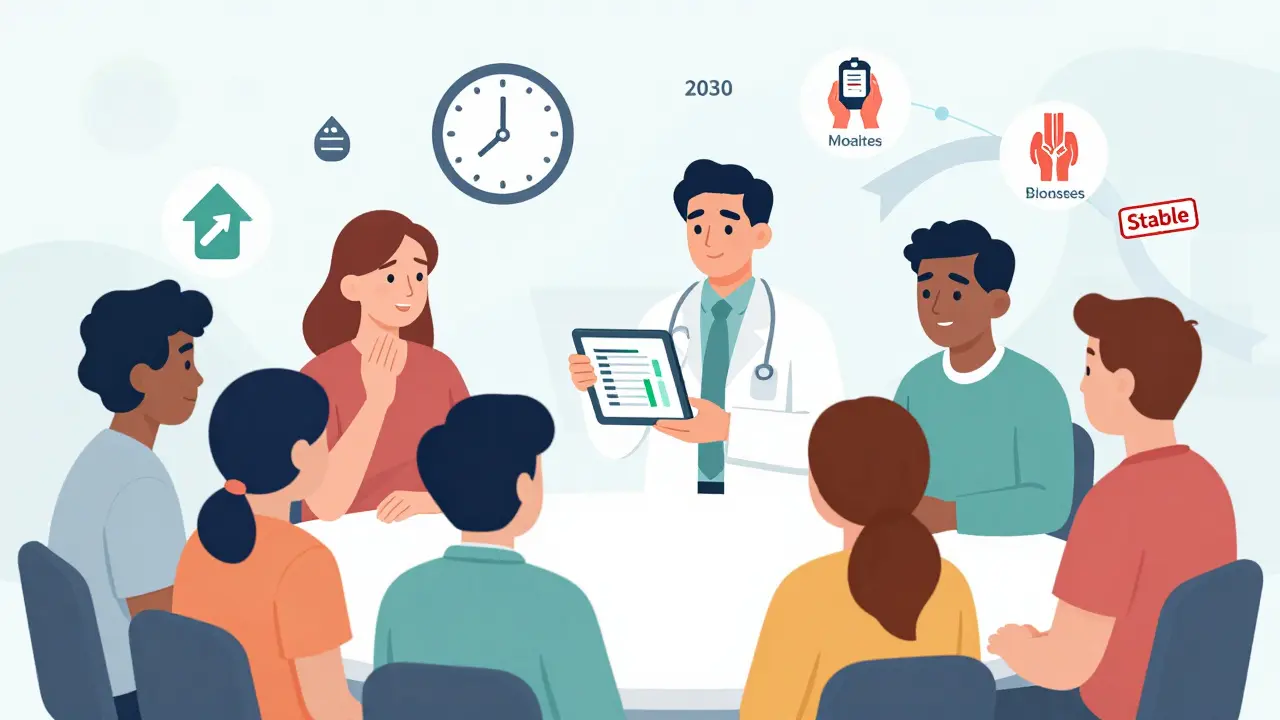
- Shared decision-making. The best outcomes happen when patients are part of the conversation. “I know this feels risky. Let’s look at the data together. Here’s what we know about this biosimilar. Here’s what we’ll watch for.”
- Interchangeable biosimilars. The FDA is moving toward approving more biosimilars as “interchangeable,” meaning pharmacists can switch them without asking the doctor. This is a big step. It signals confidence-not just from regulators, but from science.
One clinic in Ohio started offering patients a 15-minute video with their pharmacist explaining biosimilars before switching. Within six months, 82% of patients agreed to the switch. Only 3% reported side effects worse than before. That’s not luck. That’s good communication.
What Can You Do?
If you’re being asked to switch:
- Ask: “Is this biosimilar approved by the FDA as equivalent to my current drug?”
- Ask: “Has this been tested in people with my condition?”
- Ask: “Will my out-of-pocket cost change?”
- Ask: “Can we monitor how I respond? What signs should I watch for?”
- Ask: “Can I try it for a few months and switch back if needed?”
You don’t have to accept a switch blindly. You have the right to understand it. And you have the right to say no-if you’re not ready.
But if you’re told it’s safe, effective, and you’ll be monitored closely? The data is clear: biosimilars work. They’re not a gamble. They’re science, refined.
What’s Next?
By 2030, nearly 120 biologic drugs will lose patent protection. That’s hundreds of billions in potential savings. But if patients stay afraid, those savings won’t reach the people who need them.
Experts predict adoption rates could hit 50% by 2030-if education, transparency, and patient trust keep improving. The science is there. The savings are real. The question isn’t whether biosimilars work. It’s whether we’ll let patients know they do.
Are biosimilars safe?
Yes. Every biosimilar approved by the FDA has gone through over 100 tests, including studies in thousands of patients. They must prove no clinically meaningful differences in safety or effectiveness compared to the original biologic. The FDA monitors them just like any other drug, and adverse events are tracked closely.
Can I switch back if the biosimilar doesn’t work for me?
Absolutely. If you experience side effects or a flare-up after switching, talk to your doctor. You can return to the original biologic. Many providers start with a trial period and monitor your condition closely-using blood tests or symptom logs-to make sure the switch is working.
Why are biosimilars cheaper if they’re so complex to make?
They’re cheaper because they don’t need to repeat the full clinical trials done by the original drug. The manufacturer uses the existing safety and efficacy data from the reference product. That cuts development time and cost significantly-though it’s still far more expensive than making a generic. The savings come from competition, not cutting corners.
Do biosimilars cause more side effects?
No. Studies show side effects are nearly identical between biosimilars and their reference products. A 2025 review of 17,000 patient-years of data found no increase in serious adverse events. Any differences are usually minor and related to how the body responds to the delivery method-not the drug itself.
Why aren’t all biologics available as biosimilars yet?
It’s expensive and complicated. Developing a biosimilar costs $100-250 million and takes 8-10 years. Some manufacturers delay entry by extending patents or paying competitors to wait. The FDA is working to simplify approval, but the process is still slower than for generics. Still, over 100 biologics are expected to lose exclusivity by 2034, meaning many more biosimilars will come.
Hugh Breen
March 13, 2026 AT 01:58Bro. I switched to a biosimilar for my RA last year and honestly? Life changed. 😍 No more $1200 copays. No more panic when the insurance letter arrives. I felt nervous at first-like, ‘Is this gonna be my ‘I woke up in a hospital’ moment?’ But my doc showed me the data. 1000+ patients. Same outcomes. Same side effects. Zero drama. Now I’m the guy telling everyone in my support group to stop being scared of science. 💪
Byron Boror
March 13, 2026 AT 23:28Why are we even having this conversation? In America, we don’t settle for ‘close enough.’ If it’s not identical, it’s a gamble. And we don’t gamble with our health. This isn’t about cost-it’s about integrity. The FDA’s standards are too loose. I’ve seen too many foreign-made meds fail. Biosimilars? They’re just a Trojan horse for cheaper drugs from overseas. We need real innovation, not copycat pills with a fancy name. 🇺🇸
Lorna Brown
March 14, 2026 AT 21:24There’s something deeply philosophical here. We treat biosimilars like they’re inferior because they’re not *identical*-but isn’t that the entire point of science? To approximate perfection, not replicate it? We accept that no two human beings are identical, yet we demand perfect molecular replication from a living cell. That’s not science-it’s a fetish for control. The data says they work. The fear says they don’t. Which one are we really trusting? And why?
Also-why does ‘cheap’ automatically mean ‘unsafe’? We don’t say that about generic antibiotics. Or insulin. But somehow, when it’s a biologic, we suddenly need a miracle? Huh.
Rex Regum
March 16, 2026 AT 05:18Oh wow. So now we’re just gonna let Big Pharma swap our life-saving meds for ‘similar’ stuff because they’re ‘cheaper’? 🤡
Let me guess-this is the same logic that got us 2008’s subprime mortgage crisis. ‘It’s almost the same!’ they said. ‘Trust the system!’ they said.
Newsflash: if it’s not identical, it’s not the same. And if it’s not the same, it’s a risk. And if it’s a risk, it’s a betrayal. I’ve been on Humira for 7 years. I don’t care how much it costs. I’m not a lab rat. You don’t get to swap my medicine like a stock ticker. 😡
Kelsey Vonk
March 17, 2026 AT 00:58I read this whole thing twice. I cried a little. Not because I’m scared-but because I’m tired. Tired of being treated like a number. Tired of being told ‘it’s safe’ without being shown how. Tired of hearing ‘the system saves money’ while my wallet stays empty.
But I also saw the Ohio clinic story. 15-minute video. 82% switch rate. 3% side effects. That’s not magic. That’s care.
I think we need to stop talking about biosimilars as a ‘choice’ and start talking about them as a partnership. Between patient, doctor, pharmacist, and science. And maybe… just maybe… that’s the real breakthrough.
Emma Nicolls
March 18, 2026 AT 15:28so like… i got switched last year and i was terrified. like, full on panic. but my doc sat with me for 20 mins and showed me graphs and my bloodwork before and after. and guess what? i feel the same. no flares. no weird side effects. and my copay? half. like… half. 🤯
idk why everyone is so scared. its not magic. its just science. and if it works, why not? 🤷♀️
Richard Harris
March 20, 2026 AT 09:37Interesting read. I’m a nurse in Manchester, and I’ve seen patients switch to biosimilars for over 5 years now. The fear is real-but so is the consistency. Most of my patients report no difference in symptoms. Some even say they feel better-less bloating, less fatigue. Could be placebo? Maybe. Or maybe the stress of the high cost was making them worse.
One thing I’ve noticed: the ones who got educated before the switch? They never looked back. The ones who were blindsided? Yeah… they’re still scared. It’s not the drug. It’s the way we handle it.
Kandace Bennett
March 22, 2026 AT 00:05Oh honey. 😘 Let me break this down for you like you’re 5. Biosimilars aren’t ‘knockoffs.’ They’re the Ferrari version of generics. Think of the original biologic as a handcrafted Rolex. The biosimilar? It’s a Swiss-made replica with the same movement, same gold, same precision. It’s not ‘fake’-it’s just not made by the same guy in Geneva. And guess what? It tells time just as well.
And if you’re still scared? Sweetie… maybe you’re not ready for 21st-century medicine. We’ve got 74 FDA-approved biosimilars. Millions of patients. Zero evidence of harm. You’re not ‘protecting’ yourself-you’re clinging to a myth. 💅